Showing posts with label government. Show all posts

Thursday, 6 September 2012

Are we living in the Matrix?


I know what you're thinking — you're thinking 1. that I'm crazy and 2. that this is old hat. When The Matrix came out in 1999 many people talked about whether we live in it or not. Let me reassure you that I am not interested in that. The other day as I drove to work I was idly considering Morpheus' statements about the Matrix and I realised that although I don't believe we are living in exactly what he described, there is one social institution that, almost word for word, can replace the word Matrix when Morpheus mentions it. Consider the following quote:
The Matrix is everywhere. It is all around us. Even now, in this very room. You can see it when you look out your window or when you turn on your television. You can feel it when you go to work... when you go to church... when you pay your taxes. It is the world that has been pulled over your eyes to blind you from the truth. That you are a slave, Neo. Like everyone else you were born into bondage. Born into a prison that you cannot smell or taste or touch. A prison for your mind.
What is everywhere? What is a lie? How are we enslaved? The answer, when it struck me, was obvious: the State. In fact I think Donald Livingston is correct when he says that the modern State, while presenting itself as republic or democracy (or a combination), has little more in common with those modes of government than it has with, say, monarchy. Instead we can call it the Leviathan State, the Total State, that form of government in which one will — that of the supreme People — alone is sovereign over any and all desires of individuals themselves. Of course this is pure fiction — there is no such thing as "the People", there are only individuals. In the Total State there are broadly two classes of individuals: those who produce and pay taxes and those who consume and receive taxes. The fiction is necessary to keep the tax-payers paying without too much complaint. Speaking of fiction:
What is the Matrix? Control. The Matrix is a computer-generated dream world built to keep us under control in order to change a human being into this. [Energy]
Needless to say the dream world we live in is not the product of a computer program, it is the product of a vast edifice of ideas and lies that tell the human mind it is more free as a slave, more wealthy as a vassal, more wise to be ignorant. The State exists to control the taxed and redirect the wealth they produce for the ends of those who control the State — mostly the "liberal" intellectual and the political class. More generally it is those that live from the proceeds of taxes. For most people of either class, since the State is all they've known people promote it and prefer it:
The Matrix is a system, Neo. That system is our enemy. But when you're inside, you look around, what do you see? Businessmen, teachers, lawyers, carpenters. The very minds of the people we are trying to save. But until we do, these people are still a part of that system and that makes them our enemy. You have to understand, most of these people are not ready to be unplugged. And many of them are so inured, so hopelessly dependent on the system, that they will fight to protect it. 
 A more fitting description of those who daily defend the violence of the State even as it engages in violence against them is hard to imagine. This type of person is the chief enemy of liberty, even though he would be the chief beneficiary of it. And why? Because he believes in the State. He cherishes its power to curb the vices of others. Every year he makes his offering of cash, if grudgingly, to ensure that the dangerous liberty of others is crushed by the State. In a sense this is the core belief of those who support the Total State. They believe freedom is dangerous, not because they themselves would abuse it, but because other people would. Others would produce bad and dangerous products, others would rampage with guns, others would spend their money with profligacy, others would fail to care for the parents and children. It is fear of the liberty of others. While this fear governs all thought any excuse will do to curb the freedom of others. Most of the time the excuse is not needed, it is simply treated as self-evident, and the individual may go on in ignorance:
I know this steak doesn't exist. I know that when I put it in my mouth, the Matrix is telling my brain that it is juicy and delicious. After 9 years, you know what I have learned? [Eats the piece of steak and sighs contently] Ignorance is bliss.
Not all people are content with ignorance, however. The State needs a permanent army of intellectuals ready to do battle in its name. They constantly fight the war of ideas to make the insane and irrational basis for the State look like science and wisdom. They must be the gatekeepers of information and the teachers of the next generation. They must be in all places, at one moment an ordinary person, the next an Agent ready to crush the ideas of liberty with a chimera of arguments. Because the State cannot tolerate the spread of anti-State ideas. Its power and permanence are founded on lies and ideas, so any outbreak of truth and the ideas of liberty, that the State is not only not necessary but antithetical to human flourishing must be crushed without delay.
That means that anyone we haven't unplugged is potentially an agent. Inside the Matrix, they are everyone and they are no one. We have survived by hiding from them, by running from them, but they are the gatekeepers. They are guarding all the doors, they are holding all the keys, which means that sooner or later, someone is going to have to fight them.
I won't lie to you, Neo. Every single man or woman who has stood their ground, everyone who has fought an agent has died. But where they have failed, you will succeed. I've seen an agent punch through a concrete wall. Men have emptied entire clips at them and hit nothing but air. Yet their strength and their speed are still based in a world that is built on rules. Because of that, they will never be as strong or as fast as you can be.
Now, I admit this might be stretching the analogy a bit, but hear me out and judge for yourself. The ordinary person may occasionally wake from the fiction of the State, but when he does he faces the intellectual equivalent of an Agent: a barrage of ideas all centred around the goal of convincing him that the State is the solution to his problems, and not their principal cause. That is why every day I seek to arm myself with the only weapon that can defeat the State: truth. Truth is the sword that never loses its edge, it is the shield that remains forever intact and perfect. It kills the Leviathan by unmasking its friends as the fiends they are and defeating its hubris, turning the ordinary person who formerly loved the State into its unwavering enemy. The State lives in the mind, so every person who rejects the State, is enabled to pierce the fog of lies that surrounds it and see its true nature, is a death of the State. Every time someone wakes up and sees the justice and reason of liberty, the State dies.
Let me tell you why you're here. You're here because you know something. What you know you can't explain, but you feel it. You've felt it your entire life, that there's something wrong with the world. You don't know what it is, but it's there, like a splinter in your mind, driving you mad.
Mises knew it. He saw that all was not right, that the State could not be God. He helped provide us with the ideas that build on the foundation of human liberty, that advance the cause of freedom and bring death to the State not with violence but with the gentle whisper of thought.

The following is a modified quote, also from The Matrix. See if you can work out the original: "Do not try to defeat the State — that's impossible. Instead, only try to realize the truth: there is no State. Then you will see it is not the State that dies, only your support of it."
I know you're out there. I can feel you now. I know that you're afraid... you're afraid of us. You're afraid of change. I don't know the future. I didn't come here to tell you how this is going to end. I came here to tell you how it's going to begin. I'm going to hang up this phone, and then I'm going to show these people what you don't want them to see. I'm going to show them a world without you. A world without rules and controls, without borders or boundaries. A world where anything is possible. Where we go from there is a choice I leave to you.
Why does the State fight so stolidly against liberty? Why must it crush the ideas of freedom and spread its influence into every aspect of life? I put it to you that it is because the State is fragile. Leviathan is not a battleship but a jellyfish. Its justification is so tenuous, so patently illogical and unreasonable that it fears even a hint of truth. It cannot stand to be examined, to be argued and debated. It cannot abide opposition even from a child. That is why if we stand ready to engage the soldiers of the State, if we argue and oppose it, if every day we walk the path of truth it is as a body blow to the State. We may never wake to find that there is only seawater where before the jellyfish swum, but we can enjoy the warm glow that comes from sticking Leviathan in a tender spot. The truth can be its own reward, and that may entice us to strive against the State, not giving in to it but proceeding ever more boldly against it. I don't know the future. I do know that the Mises Institute and its academics and contributors are showing us a world without the State. A sea with no jellyfish. I, for one, intend to take a swim.

Monday, 20 August 2012

Why the carbon tax?

Julia Gillard has been having an awful time in politics because of the carbon tax. She's been roundly criticised for stating during the election that it was not on the table, then backflipping the moment she became PM (this is not an isolated case, of course). The opposition really lay into her for that. Then there's the fact that it is mathematically certain that a) the carbon tax will have no direct measurable effect on global temperatures even if in theory it did reduce overall carbon dioxide emissions and carbon dioxide is a major problem and global temperature rises are a major issue, and b) it will further hollow out the already nearly dead industrial base in Australia. Point a means that it will never be possible to tell from the global temperature measurement whether the carbon tax has had the desired effect. Point b means that production currently happening in Australia will almost certainly move to other countries where the power is cheaper and dirtier, so the nett effect will be to increase over all carbon dioxide emissions in accordance with the well-known Law of Unintended Consequences.

Given the furore and the heavy hits she's taken in the polls, and the fact that she's still the Labor leader, I have speculated in the past that it may be due to pressure from the UN that this is happening at all. It is well known that Labor and the Greens are in cahoots, especially given the fact that the Labor government is a minority government, but to me that did not seem like enough reason to waste all the Labor party's political capital in this way. UN countries really hate it when some people become too wealthy, and a carbon tax is an ideal way to really scupper a country's productive capacity and make its people poorer. Thus it's possible the UN wanted to cut us down to size. If Gillard gets a job at the UN, World Bank, IMF or ITO in the near future we'll know beyond a reasonable doubt, but in the mean time there is another issue that has come up.

Recently ol' Julia has been criticising the states for the extreme rise in electricity prices, and threatening that if prices don't come down the Federal Government will act to force them down. For anyone familiar with economics this should be ringing alarm bells the size of planets. A few of the questions that might be raised are:
If prices genuinely are too high, why isn't the "market competition" that's been introduced in recent years driving down the prices?
If prices are simply the response to carbon taxes, won't a plan to force them down cause shortages?
Why didn't the energy futures market provide a better buffer to the power prices?

This threat from the Federal Government got me thinking about who is benefiting from this whole thing. In politics one should always look for where the money is. The people who asked for a given piece of legislation are usually the ones who benefit from it, this is merely common sense.

One group that might benefit from this bill is producers of "green" power and the manufacturers of the technology used in its production (mostly windmills). Of course, it's mostly the foreign manufacturers of the technology are helped because CO2 inducing electricity must be used in the types of heavy manufacture that producers of green power technology employ.

Another group that could conceivably benefit is the Federal Government itself. This could well be some type of power grab to seize control of all of Australia's power infrastructure from the states. Another obvious benefit is the potential for greater tax takes and indirect control of the energy producers themselves who will be only too happy to beg and roll over if the Federal Government threatens to raise taxes.

The third group I can think of that might benefit is unionised and or skilled labour. Expensive energy makes capital intensive processes more expensive and will increase the over-all demand for labour. This, in turn, will drive up the price of labour, especially of skilled labour of the type that can stand in for capital goods. Along with the controls over entry into the skilled labour market due to barriers to entry, licensing, compulsory unionisation and a number of other regulations this could well have a significant effect on the price of skilled labour, which will of course have a negative impact on the general welfare and particularly on the poor.

Now, I know that any minute now you expect me to reach for my tinfoil hat. Why so conspiratorial? you might well ask. We have learned the hard way that in a democracy politicians are still only doing what will get them more votes, money and power. I think I've outlined a credible case of how those three objectives might be served by this bill. The policy is merely a continuation of the fundamentally fascist way public affairs and "public good" businesses have been conducted in Australia for some time, and most especially since the acceleration of privatisation during the Howard government.

I believe this attack by Gillard on the states is an extremely worrying sign, another expression of the economic fallacy that if a small group of monopolists are doing a bad job the solution is to create a single monopoly. Time will tell if it will materialise into a fully-fledged takeover of the power grid by the Federal Government but I wouldn't be the slightest bit surprised if that were the endgame.

Monday, 6 August 2012

They are there to see that Justice is Done.

The following comes from an episode of The Games:

John: "Who are the other side?"
Dennis: "When I say 'the other side' I mean the people running the inquiry."
"Who are they?"
"There's a chairman and a barrister who's called Counsel Assisting."
"And who employs these people?"
"Well, they're employed by the legal process. They're there to see that justice is done. That is their duty, that is their sacred trust, and that supervenes any and all other responsibilities in their mind."
"Yeah. They're employed by the government, aren't they?"
"They're indipendent people, chosen for their jurisprudential and evidential skills in areas deemed most useful for determinations of this kind."
"Are they paid for their services, these people?"
"Oh, some moiety may inhere in work of this type, of some kind, yes."
"And who pays them?"
"The question of emoluments would rest with the state in this instance."
"Yeah, they're paid for by the government."
"Yes."
"The government the Mininster's a minister in."
"Well, the enquiry will have quite clear guidelines."
"And who writes the guidelines?"
"They'll be prepared by the Attorney General."
"Yeah, another minister. So the government's going to hold an inquiry into its own activities, supervised by itself and run under conditions jacked up by the Attorney General. It's no wonder they want a bit of fresh blood in there, is it?"
Sound familiar?

Wednesday, 18 April 2012

Reasons why you should never buy a government bond

If there's one financial asset that should really be treated like radioactive ebola virus, it's the government bond. In the past this was not necessarily true, because way back when gold and silver were money and when the government's debts fell due it had to find the money somewhere to repay it. It had to increase taxes. This might not sound like such a fantastic thing, and you right, it's not - really all governments should run balanced budgets no matter what, but at least back then people knew what was going to happen. Of course such tax hikes in the wake of government borrowing were pretty unpopular so all monarchs were always looking for a way around that and the most effective instrument was coin clipping. Governments would reduce the precious metal content of their coins but remint them at the old valuation. When this became really popular after a while you end up with something like the late Roman Denarius with a precious metal content of 0-1%.

All this is to underline why government debt is always a bad investment. In recent times the debt of stable, high performing economies like the US, Switzerland and Germany has come under such high demand that in Switzerland the yield is now negative. In other words, the price of the bonds themselves are now so high that investors are certain to lose money, even after you consider the interest the bonds are going to pay. They are willing to lose the money because they are so afraid of any other inverstment crashing and they want something that is certain to repay their money. All of these investors are going to lose their money, or if not them, then whoever ends up with the equivalent of those bonds down the track. This is certain. Even the ever prudent Swiss or the mighty Germans will eventually end up in the same sort of tight spot Greece, the US and all the rest. Let me explain why.

First we need to examine the purpose of government debts. When a private company goes into debt it usually uses that money to invest in plant, land, resources, anything they need to grow the business and generate the profits that are going to repay the loan plus interest and leave them with plenty of new cash left over. When the government goes into debt it never does it with the intention of spending on things that will eventually repay the debt. This was originally the theory - the government would borrow from its citizens, do some large construction project like a road or a dam or whatever it might be, and as a result of this new infrastructure the economy would be more productive and the tax take would increase and allow the repayment of the original debts. Precious though this theory was to satisfy the general populace that they wouldn't suffer a burden of extra taxes later to make up for it this is not how it has ever, to my knowledge, worked out. The investment was always supposed to pay itself back in taxes and even if it didn't, the bond holders had no fear because if the project turned out to be a dud they would get their money back anyway because the government could always tax the rest of the people more to make up the shortfall. However this lovely theory has never been a reality. The reasons are multiple but the chief reasons are a) if the government's idea for an investment was profitable private investors would be doing it already and b) if - and I stress, if - the government's plan actually did make the economy more productive and did increase the tax take, none of that tax was ever earmarked for the purposes of repaying the debt. It was always more tempting to spend that money straight away and worry about the bondholders when the time came. And what typically happens when it actually does come time to worry about the bondholders? Naturally the government does not actually have the money, so instead of risking the unpopularity of forcing the populace to actually pay for the stuff the goverment had bought on their behalf, it simply sells new bonds to pay off the old bonds.

Are you seeing the problem now? You see now why those bondholders were stupid to buy the bonds at all? The government's incentives always lie towards repaying old debts with new debts. That's why nearly all western governments have had a sustained increase in debt. No one ever stopped to think about the fact that these were loans and that eventually people might ask for their money back and lose faith in the government to such a degree that they would not be willing to give up any more. Everyone knows the US government is never ever going to repay their bonds, and even so investors are still giving it up for new bonds in the certain knowledge that the money ultimately won't be repaid. They simply expect that at some future date they'll be able to find another sucker to sell it to before the bottom falls out, or that the bond will fall due and they won't be trapped into buying back into America's pyramid scheme right before it all goes west. The only reason, in other words, that the bonds have any value at all right now is because the investors expect to be able to sell them or get paid back by the US government before it has to resort to devaluing the Dollar, which, by the way, it has already been doing heavily.

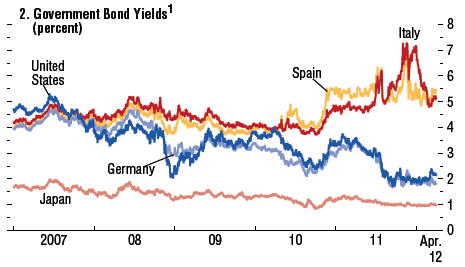
Greece is substantially different from the US. In the US if they really wanted to give those bond holders back their dollars they could always print some up and give everyone their full amount. Of course that would result in instant hyperinflation the minute the investors started to try to buy real stuff with that money, but their bank accounts would at least have the right number in them. In Greece they're on the Euro standard which is one of the reasons for their woes. They can't repay the bonds they've issued because the only place for those euros to come from is taxes and the only way the economy could ever sustain such a tax take is if they were brilliant exporters to the rest of the Eurozone or, failing that, to anywhere else in the world. Needless to say, they are not. As a result of this Greek bond holders (not necessarily Greeks, people holding their bonds) have already had to take a "voluntary haircut" of 74%. That means that every single person who owned a Greek bond just before the bottom fell out has lost 74% of his money and that's despite the bailouts. Spanish, Portuguese, Italian, and other bond holders are on the same road, which is why recently they've started to edge away from those bonds, resulting in a spike in long-term bond yields:
So, to recap: you should never buy a bond because no government will ever pay it back in the long term. Even if you get your money back it's at the expense of some other sucker down the line, and even if he gets his money back in nominal terms its value will be so low he'll wish he hadn't. The eventual crisis is certain to come and when it does the economy of that country is going to tank. Do you want to be partly responsible for making that government's spending possible? Do you want to wear even a millionth part of the blame for lowering the interest rate on those bonds, which kept the state spending and made the eventual collapse worse? State issued bonds are simply a deferred stealth tax - a tax that deludes people into thinking it's an investment and produces a massive crisis when people snap out of it and realise they'll never see their money again. Now that you know, if you have a conscience or any compassion for your fellow man, don't buy a government bond. Not a single one. Not ever.

Wednesday, 28 September 2011

9/11 Conspiracy Theories

The Americans love a good conspiracy theory. It's been their major export for some decades now, so when the 9/11 attacks occurred the cynical could have placed safe bets on the emergence of a fresh series of conspiracy theories about the events of that terrible day. I'm not going to try to answer all the hair-brained stuff that's come to light from dark corners of the internet - that has been done much more comprehensively and expertly than I could do, but I do want to talk about some of the things the conspiracy theorists have right and wrong.

The origin of conspiracy
I think the conspiracy theories are very significantly influenced by the convenience that the attacks afforded the US government, particularly Dick Chainey. In all times of great tragedy there are those that abuse it for gains in power or status or money, or all of the above. Those that capitalise on the events for personal gain are perfect fodder for the conspiracy theorists' delusions - after all, the gains are great, so they had motive to cause these events. In the case of 9/11 the invasion of Iraq is particularly glaring. To this day I don't know the motivation for doing it. By comparison, invading Afghanistan was perfectly logical (Bin Laden was a Saudi) and a measured response (more than 8000 civilians dead and counting) to the 9/11 attacks. I can only assume that it was galling that in 1991 they couldn't actually invade and they wanted to make up for it, combined with a perceived need for the oil security. If so, it's just about the most expensive oil ever bought, since it has cost at least $3 trillion, which is short to write but it's a truly catastrophic amount of money, and if anything it's a gross underestimate since many fine young men have suffered severe and permanent physical and mental trauma, and of course a fair number have been killed in action.

Leaving aside the legitimacy and pointfullness of the war, though, it's a great "motive" for the 9/11 theorists to cite. Apparently the desire by some to go to war was so extreme that they would go to enormous lengths to make it happen, even orchestrating a terrorist attack. Here follows some conspiracy theories and my generalised rebuttal.

Controlled demolition
For me, this one pretty much takes the cake in terms of implausibility. The American government secretly wired a building in the middle of their greatest city with explosives? The explosives were not set off by the massive shock of a heavy jet hitting them and the resultant jet-fuel fireball? And they worked perfectly, just at the moment the towers were starting to fall?
and someone was watching, waiting for the perfect moment to set them off even though the buildings might easily have collapsed anyway? This gets a full 5/5 flying saucers. There are some outstanding facts that are hard to explain for the "conventional" school (i.e., the buildings came down because they were hit by heavy jets and exposed to extensive, raging fires) but 9/11 is a unique event, so there are bound to be some facts that are hard to understand. A mysterious fountain of sparks that looks suspiciously like thermite is one example. Unfortunately quite a few "experts" have gone on record as saying that it was controlled demolition. I'm all for academic freedom, but these guys are missing a trick: THE BUILDINGS WERE HIT BY HEAVY JETS. Stress concentration is one thing I see not mentioned by any structural or materials engineer who goes for the controlled demolition theory. When combined with fire, it's obvious to me why these buildings failed while no other steel structure has ever collapsed due to fire. A significant amount of the supporting structure had been wiped out asymmetrically. This would seem to cause a torque on the whole building around where the plane hit, and combined with the effect of heat lowering the yield stress of steel ... like I said, obvious.

Aircraft autopiloted into WTC

This is as daft possibly even dafter than the one above. The terrorists were in the cockpit. They had taken flying lessons. We have lots of documentary evidence for both of those facts. So why is it that someone would insist the planes were guided into the WTC by their autopilots which had been remote programmed? I'm not saying this is impossible, but on a scale of 1 to 5 UFOs it gets 4.5 for sheer brain shutdown.

United 93 was quickly removed/shot down by missile
This is one the conspiracy theorists have right. The wreckage from United 93 was removed very fast - at the moment of impact, in fact. By an enormous jet fuel fireball. The circumstances of its crash were unlike most aircraft crashes. Most aircraft crashes that happen on land are what you might call a severely botched landing. The pilots try to land or mitigate the crash so lose altitude slowly if possible and come in parallel to the ground. Tragically, the evident struggle in the cockpit of that plane caused the controls to be manipulated in such a way that the plane made a hard right bank - I'm guessing a rudder hard-over, which would be consistent with someone kicking indescriminately if they were struggling - and then went nose first into the ground. Such an impact is unusual in that there is a lot of force acting directly on the airframe, causing it to shatter into much smaller pieces than normal. The concomitant fireball would send these pieces right out of the park. The sheer number of witness accounts make this one a fairly watertight case so I give it 4.5 crop circles out of five.

In a sense all of these conspiracy theories are the same. It's always the government or "they" - forces within the government - that is doing it to its own people. And in a sense they have it right - all governments do terrible things to their own people, especially in this current age of unprecedented power over their people. But conspiracy theorists also miss the point. Airing conspiracies with house of cards levels of documentation is not going to convince people en masse - indeed, a lot of sites propound a whole swathe of conspiracy theories, some legitimate concerns, and others complete bunkum, and in doing this play into the hands of any forces that genuinley want to keep certain information out of public eye. The best place for a true conspiracy is among half a dosen fakes. That way no one with an ounce of common sense is going to believe any of it. In that way there is conspiracy hegemony: either you believe all the conspiracies (if you have taken leave of your senses) or you believe none. To give serious thought to any conspiracy automatically moves you in to the conspiracy camp and gives your word the same weight as someone who still believes in aliens, so few people would do it.

Conspiracy theorists' credibility problem derives from their ignorance of Ockham's razor and Hanlon's razor. Combine this with sources that themselves are not credible (some have reasonably scientific methods but also point to other conspiracy sites or known conspiracists) and cherry-picking of evidence, and you have total loss of credibility. The only difference between an investigative journalist and a conspiracist is that one is a lot more rigorous. In short, conspiracists suffer from insufficient skepticism and rigor. Until and unless they get their act together there's little chance that any genuinely concerning things they report will ever become known before it's too late to do anything about them.

The other major problem with all of these conspiracy theories is they fail to draw attention to the civil liberties that were considered basic human rights before the attacks but have since been eroded or destroyed. New powers were granted the government, just as new powers were granted Hitler during crises, and these powers were mostly used to repress ordinary citizens, although the rhetoric was about protecting the public from sleeper terrorists and the like.

I always cringed when Bush said something like, "They hate us for our freedoms." From day one I knew that couldn't possibly be true. No one attacks someone else just because they have more liberty. The reasons for the attack are complicated no doubt, but they tend to boil down to a reaction to American imperialism. Speaking of liberty in this way debases it by making it a pretext for treading on the liberties of foreigners in the middle east and the people at home. Governments around the world have proved that Bush's retoric has a place: we the free people can say of most governments that, "They hate us for our freedoms."