Julia Gillard has been having an awful time in politics because of the carbon tax. She's been roundly criticised for stating during the election that it was not on the table, then backflipping the moment she became PM (this is not an isolated case, of course). The opposition really lay into her for that. Then there's the fact that it is mathematically certain that a) the carbon tax will have no direct measurable effect on global temperatures even if in theory it did reduce overall carbon dioxide emissions and carbon dioxide is a major problem and global temperature rises are a major issue, and b) it will further hollow out the already nearly dead industrial base in Australia. Point a means that it will never be possible to tell from the global temperature measurement whether the carbon tax has had the desired effect. Point b means that production currently happening in Australia will almost certainly move to other countries where the power is cheaper and dirtier, so the nett effect will be to increase over all carbon dioxide emissions in accordance with the well-known Law of Unintended Consequences.
Given the furore and the heavy hits she's taken in the polls, and the fact that she's still the Labor leader, I have speculated in the past that it may be due to pressure from the UN that this is happening at all. It is well known that Labor and the Greens are in cahoots, especially given the fact that the Labor government is a minority government, but to me that did not seem like enough reason to waste all the Labor party's political capital in this way. UN countries really hate it when some people become too wealthy, and a carbon tax is an ideal way to really scupper a country's productive capacity and make its people poorer. Thus it's possible the UN wanted to cut us down to size. If Gillard gets a job at the UN, World Bank, IMF or ITO in the near future we'll know beyond a reasonable doubt, but in the mean time there is another issue that has come up.
Recently ol' Julia has been criticising the states for the extreme rise in electricity prices, and threatening that if prices don't come down the Federal Government will act to force them down. For anyone familiar with economics this should be ringing alarm bells the size of planets. A few of the questions that might be raised are:
If prices genuinely are too high, why isn't the "market competition" that's been introduced in recent years driving down the prices?
If prices are simply the response to carbon taxes, won't a plan to force them down cause shortages?
Why didn't the energy futures market provide a better buffer to the power prices?
This threat from the Federal Government got me thinking about who is benefiting from this whole thing. In politics one should always look for where the money is. The people who asked for a given piece of legislation are usually the ones who benefit from it, this is merely common sense.
One group that might benefit from this bill is producers of "green" power and the manufacturers of the technology used in its production (mostly windmills). Of course, it's mostly the foreign manufacturers of the technology are helped because CO2 inducing electricity must be used in the types of heavy manufacture that producers of green power technology employ.
Another group that could conceivably benefit is the Federal Government itself. This could well be some type of power grab to seize control of all of Australia's power infrastructure from the states. Another obvious benefit is the potential for greater tax takes and indirect control of the energy producers themselves who will be only too happy to beg and roll over if the Federal Government threatens to raise taxes.
The third group I can think of that might benefit is unionised and or skilled labour. Expensive energy makes capital intensive processes more expensive and will increase the over-all demand for labour. This, in turn, will drive up the price of labour, especially of skilled labour of the type that can stand in for capital goods. Along with the controls over entry into the skilled labour market due to barriers to entry, licensing, compulsory unionisation and a number of other regulations this could well have a significant effect on the price of skilled labour, which will of course have a negative impact on the general welfare and particularly on the poor.
Now, I know that any minute now you expect me to reach for my tinfoil hat. Why so conspiratorial? you might well ask. We have learned the hard way that in a democracy politicians are still only doing what will get them more votes, money and power. I think I've outlined a credible case of how those three objectives might be served by this bill. The policy is merely a continuation of the fundamentally fascist way public affairs and "public good" businesses have been conducted in Australia for some time, and most especially since the acceleration of privatisation during the Howard government.
I believe this attack by Gillard on the states is an extremely worrying sign, another expression of the economic fallacy that if a small group of monopolists are doing a bad job the solution is to create a single monopoly. Time will tell if it will materialise into a fully-fledged takeover of the power grid by the Federal Government but I wouldn't be the slightest bit surprised if that were the endgame.
Showing posts with label tax. Show all posts
Showing posts with label tax. Show all posts
Monday, 20 August 2012

Wednesday, 18 April 2012
Reasons why you should never buy a government bond
If there's one financial asset that should really be treated like radioactive ebola virus, it's the government bond. In the past this was not necessarily true, because way back when gold and silver were money and when the government's debts fell due it had to find the money somewhere to repay it. It had to increase taxes. This might not sound like such a fantastic thing, and you right, it's not - really all governments should run balanced budgets no matter what, but at least back then people knew what was going to happen. Of course such tax hikes in the wake of government borrowing were pretty unpopular so all monarchs were always looking for a way around that and the most effective instrument was coin clipping. Governments would reduce the precious metal content of their coins but remint them at the old valuation. When this became really popular after a while you end up with something like the late Roman Denarius with a precious metal content of 0-1%.
All this is to underline why government debt is always a bad investment. In recent times the debt of stable, high performing economies like the US, Switzerland and Germany has come under such high demand that in Switzerland the yield is now negative. In other words, the price of the bonds themselves are now so high that investors are certain to lose money, even after you consider the interest the bonds are going to pay. They are willing to lose the money because they are so afraid of any other inverstment crashing and they want something that is certain to repay their money. All of these investors are going to lose their money, or if not them, then whoever ends up with the equivalent of those bonds down the track. This is certain. Even the ever prudent Swiss or the mighty Germans will eventually end up in the same sort of tight spot Greece, the US and all the rest. Let me explain why.
First we need to examine the purpose of government debts. When a private company goes into debt it usually uses that money to invest in plant, land, resources, anything they need to grow the business and generate the profits that are going to repay the loan plus interest and leave them with plenty of new cash left over. When the government goes into debt it never does it with the intention of spending on things that will eventually repay the debt. This was originally the theory - the government would borrow from its citizens, do some large construction project like a road or a dam or whatever it might be, and as a result of this new infrastructure the economy would be more productive and the tax take would increase and allow the repayment of the original debts. Precious though this theory was to satisfy the general populace that they wouldn't suffer a burden of extra taxes later to make up for it this is not how it has ever, to my knowledge, worked out. The investment was always supposed to pay itself back in taxes and even if it didn't, the bond holders had no fear because if the project turned out to be a dud they would get their money back anyway because the government could always tax the rest of the people more to make up the shortfall. However this lovely theory has never been a reality. The reasons are multiple but the chief reasons are a) if the government's idea for an investment was profitable private investors would be doing it already and b) if - and I stress, if - the government's plan actually did make the economy more productive and did increase the tax take, none of that tax was ever earmarked for the purposes of repaying the debt. It was always more tempting to spend that money straight away and worry about the bondholders when the time came. And what typically happens when it actually does come time to worry about the bondholders? Naturally the government does not actually have the money, so instead of risking the unpopularity of forcing the populace to actually pay for the stuff the goverment had bought on their behalf, it simply sells new bonds to pay off the old bonds.
Are you seeing the problem now? You see now why those bondholders were stupid to buy the bonds at all? The government's incentives always lie towards repaying old debts with new debts. That's why nearly all western governments have had a sustained increase in debt. No one ever stopped to think about the fact that these were loans and that eventually people might ask for their money back and lose faith in the government to such a degree that they would not be willing to give up any more. Everyone knows the US government is never ever going to repay their bonds, and even so investors are still giving it up for new bonds in the certain knowledge that the money ultimately won't be repaid. They simply expect that at some future date they'll be able to find another sucker to sell it to before the bottom falls out, or that the bond will fall due and they won't be trapped into buying back into America's pyramid scheme right before it all goes west. The only reason, in other words, that the bonds have any value at all right now is because the investors expect to be able to sell them or get paid back by the US government before it has to resort to devaluing the Dollar, which, by the way, it has already been doing heavily.
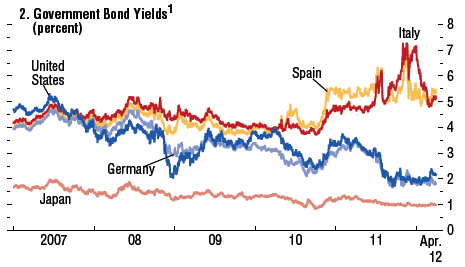
Greece is substantially different from the US. In the US if they really wanted to give those bond holders back their dollars they could always print some up and give everyone their full amount. Of course that would result in instant hyperinflation the minute the investors started to try to buy real stuff with that money, but their bank accounts would at least have the right number in them. In Greece they're on the Euro standard which is one of the reasons for their woes. They can't repay the bonds they've issued because the only place for those euros to come from is taxes and the only way the economy could ever sustain such a tax take is if they were brilliant exporters to the rest of the Eurozone or, failing that, to anywhere else in the world. Needless to say, they are not. As a result of this Greek bond holders (not necessarily Greeks, people holding their bonds) have already had to take a "voluntary haircut" of 74%. That means that every single person who owned a Greek bond just before the bottom fell out has lost 74% of his money and that's despite the bailouts. Spanish, Portuguese, Italian, and other bond holders are on the same road, which is why recently they've started to edge away from those bonds, resulting in a spike in long-term bond yields:
 So, to recap: you should never buy a bond because no government will ever pay it back in the long term. Even if you get your money back it's at the expense of some other sucker down the line, and even if he gets his money back in nominal terms its value will be so low he'll wish he hadn't. The eventual crisis is certain to come and when it does the economy of that country is going to tank. Do you want to be partly responsible for making that government's spending possible? Do you want to wear even a millionth part of the blame for lowering the interest rate on those bonds, which kept the state spending and made the eventual collapse worse? State issued bonds are simply a deferred stealth tax - a tax that deludes people into thinking it's an investment and produces a massive crisis when people snap out of it and realise they'll never see their money again. Now that you know, if you have a conscience or any compassion for your fellow man, don't buy a government bond. Not a single one. Not ever.
All this is to underline why government debt is always a bad investment. In recent times the debt of stable, high performing economies like the US, Switzerland and Germany has come under such high demand that in Switzerland the yield is now negative. In other words, the price of the bonds themselves are now so high that investors are certain to lose money, even after you consider the interest the bonds are going to pay. They are willing to lose the money because they are so afraid of any other inverstment crashing and they want something that is certain to repay their money. All of these investors are going to lose their money, or if not them, then whoever ends up with the equivalent of those bonds down the track. This is certain. Even the ever prudent Swiss or the mighty Germans will eventually end up in the same sort of tight spot Greece, the US and all the rest. Let me explain why.
First we need to examine the purpose of government debts. When a private company goes into debt it usually uses that money to invest in plant, land, resources, anything they need to grow the business and generate the profits that are going to repay the loan plus interest and leave them with plenty of new cash left over. When the government goes into debt it never does it with the intention of spending on things that will eventually repay the debt. This was originally the theory - the government would borrow from its citizens, do some large construction project like a road or a dam or whatever it might be, and as a result of this new infrastructure the economy would be more productive and the tax take would increase and allow the repayment of the original debts. Precious though this theory was to satisfy the general populace that they wouldn't suffer a burden of extra taxes later to make up for it this is not how it has ever, to my knowledge, worked out. The investment was always supposed to pay itself back in taxes and even if it didn't, the bond holders had no fear because if the project turned out to be a dud they would get their money back anyway because the government could always tax the rest of the people more to make up the shortfall. However this lovely theory has never been a reality. The reasons are multiple but the chief reasons are a) if the government's idea for an investment was profitable private investors would be doing it already and b) if - and I stress, if - the government's plan actually did make the economy more productive and did increase the tax take, none of that tax was ever earmarked for the purposes of repaying the debt. It was always more tempting to spend that money straight away and worry about the bondholders when the time came. And what typically happens when it actually does come time to worry about the bondholders? Naturally the government does not actually have the money, so instead of risking the unpopularity of forcing the populace to actually pay for the stuff the goverment had bought on their behalf, it simply sells new bonds to pay off the old bonds.
Are you seeing the problem now? You see now why those bondholders were stupid to buy the bonds at all? The government's incentives always lie towards repaying old debts with new debts. That's why nearly all western governments have had a sustained increase in debt. No one ever stopped to think about the fact that these were loans and that eventually people might ask for their money back and lose faith in the government to such a degree that they would not be willing to give up any more. Everyone knows the US government is never ever going to repay their bonds, and even so investors are still giving it up for new bonds in the certain knowledge that the money ultimately won't be repaid. They simply expect that at some future date they'll be able to find another sucker to sell it to before the bottom falls out, or that the bond will fall due and they won't be trapped into buying back into America's pyramid scheme right before it all goes west. The only reason, in other words, that the bonds have any value at all right now is because the investors expect to be able to sell them or get paid back by the US government before it has to resort to devaluing the Dollar, which, by the way, it has already been doing heavily.
Greece is substantially different from the US. In the US if they really wanted to give those bond holders back their dollars they could always print some up and give everyone their full amount. Of course that would result in instant hyperinflation the minute the investors started to try to buy real stuff with that money, but their bank accounts would at least have the right number in them. In Greece they're on the Euro standard which is one of the reasons for their woes. They can't repay the bonds they've issued because the only place for those euros to come from is taxes and the only way the economy could ever sustain such a tax take is if they were brilliant exporters to the rest of the Eurozone or, failing that, to anywhere else in the world. Needless to say, they are not. As a result of this Greek bond holders (not necessarily Greeks, people holding their bonds) have already had to take a "voluntary haircut" of 74%. That means that every single person who owned a Greek bond just before the bottom fell out has lost 74% of his money and that's despite the bailouts. Spanish, Portuguese, Italian, and other bond holders are on the same road, which is why recently they've started to edge away from those bonds, resulting in a spike in long-term bond yields:
 So, to recap: you should never buy a bond because no government will ever pay it back in the long term. Even if you get your money back it's at the expense of some other sucker down the line, and even if he gets his money back in nominal terms its value will be so low he'll wish he hadn't. The eventual crisis is certain to come and when it does the economy of that country is going to tank. Do you want to be partly responsible for making that government's spending possible? Do you want to wear even a millionth part of the blame for lowering the interest rate on those bonds, which kept the state spending and made the eventual collapse worse? State issued bonds are simply a deferred stealth tax - a tax that deludes people into thinking it's an investment and produces a massive crisis when people snap out of it and realise they'll never see their money again. Now that you know, if you have a conscience or any compassion for your fellow man, don't buy a government bond. Not a single one. Not ever.
Friday, 7 October 2011
The answer is more tax. What was the question again?
Two recent stories reported through various media no doubt, but read by me on the Conversation's website, have made me near apoplectic. The first is a report on the recent tax forum and the second concerns some ideas on a junk food tax for Australia. The latter is of course at least partly catalysed by Denmark's new "fat tax".
Let me deal with the fat tax first. The suggestion he makes is for a rather broader junk food tax:
As usual no one is asking whether it is wise to give the government more central control of the food supply, or whether it is democratic to interfere in the market, or whether it is the government's responsibility to change people's lifestyles. In other words, no one is even considering whether liberty might be more important than the obesity epidemic. It's not even on their minds. A poll from two years ago showed that 64% or so of Australians would support such a tax, while apparently only 16% would strongly oppose it. At root this seems to be at least in part due to the transfer of responsibility away from the individual. By extension the responsibility is transferred to society, especially the government. Thus if there is a problem in society, it is because the government is not doing enough. No one ever considers whether the government should do anything at all, or whether it is doing too much.
He admits that poor people buy this stuff more. Isn't anyone but me going to join the dots and see that this tax is logically going to be mostly on poor people? Is it going to make the population healthier in the long term by enabling more rich people to eat veggies for cheap and forcing the poor to eat rice instead? How can you increase someone's quality of life by taking more of their money? How about if we acknowledge that poor people buy this stuff because they don't have money for more genteel pleasures? How about if we increased the tax free threshold so they could afford some more harmless fun?
The commenters are no more enlightened than this egregious proponent of misappropriation.
Says Yolanda Newman:
Damien Gildea has never heard of mission creep:
This is turning out to be one long post. We now turn to the second story: that of the tax forum.
Fortunately I have a lot less to say about this one. Some suggested actions were:
Let me deal with the fat tax first. The suggestion he makes is for a rather broader junk food tax:
In other words, Denmark's tax does not go far enough. Well I'm glad we sorted that out. I was beginning to think you might only say that it was going too far by also taxing butter and oil. Silly me.If we want a tax that’s going to be effective in reducing obesity in the longer term, we need a broader approach to taxing unhealthy foods rather than just measuring the fat content.
We need to consider the salt, sugar and fat content, along with an assessment of the benefits of nutrients such as fibre, and fruit and vegetable content.
Put all of this information together and you’ll get an assessment of the overall healthiness of the food. A tax should be applied on this basis, not just the saturated fat content.
As usual no one is asking whether it is wise to give the government more central control of the food supply, or whether it is democratic to interfere in the market, or whether it is the government's responsibility to change people's lifestyles. In other words, no one is even considering whether liberty might be more important than the obesity epidemic. It's not even on their minds. A poll from two years ago showed that 64% or so of Australians would support such a tax, while apparently only 16% would strongly oppose it. At root this seems to be at least in part due to the transfer of responsibility away from the individual. By extension the responsibility is transferred to society, especially the government. Thus if there is a problem in society, it is because the government is not doing enough. No one ever considers whether the government should do anything at all, or whether it is doing too much.
You only incentivise the poor, because the middle class and above have so much money that only rediculous tax hikes will deter them from buying anything they really want and could otherwise afford. Unfortunately, junk foods are not as elastic as they think because they are highly preferred, so people will give up other things in order to buy them, rather than decreasing consumption to save money. The nett effect of such a scheme, then, as I see it, would be to siphon money from the poor, who may have few pleasures in life apart from food, and give it to the rich - who could have afforded the vegetables anyway and would buy them anyway because they can compensate for a boring diet (not that they necessarily have one) by buying more expensive things that give them pleasure instead. So once again the star economists have proven that they have no idea how people work. They think you just have to nudge them in the right direction by giving them a little hit to the wallet, but this will have no effect if people value the item more than you're taxing it. People drink coke because it is nice, not because it is cheap. The fact that it's cheap just means that the marginal fans might buy it. The hard-core fans will still buy it in nearly the same quantities if you treble the price. Everyone else will switch to an alternative they prefer, but that alternative will still be a sweet cold drink.So you tax the foods that are high in sugar, fat and salt, and you use the revenue that’s generated to subsidise fruit and vegetables and some other healthy foods.
This would create more of an incentive for people to not only stop eating the unhealthy food but also choose the healthier foods.
There is also a lot of evidence from other public health measures, such as tobacco and alcohol, which shows when you increase the price of goods through a tax, consumption clearly decreases.As I was saying, the hard-core don't stop buying it, only people who could take it or leave it.
We also need to consider other interventions such as restricting the marketing of unhealthy foods, improving food labelling (with a simple traffic light labelling system), and implementing public education campaigns, among other things.Tobacco, 40 years ago. We need to restrict advertising, especially to children. We need health warnings. We need education campaigns. Well actually due to the "education" campaign that has already been waged for so long, everyone already knows junk foods are bad for you and contribute to obesity. Some people haven't responded by stopping consumption of them, so instead of telling them how bad it is we now have to coerce them to stop consumption. The assumption here is that the poor bastards still eating this stuff are so stupid, ignorant or hedonistic that the only thing they'll respond to is a price signal. The sheer paternalistic, condescending smugness of it makes me sick.
Or conversely, to make it harder for them to make unhealthy choices, right? Unless all the tax revenue is spent making healthier food cheaper, all this will do is raise the general price level of food and make life for the poor just that little bit worse. And we know from experience that governments are incapable of earmarking funds. All your taxes just go into a general pool of money whose sole purpose is to buy more low income voters (because they're the most common type, thanks to the huge tax burden) by increasing welfare payments or other subsidies. GST is not earmarked for economic incentives, income tax is not earmarked for income protection, petroleum excise is not earmarked for transport infrastructure. Junk food tax would not be spent only on making healthy food cheaper, it would give the government an excuse to increase their anti-junk food education campaigns in order to enable them to raise the tax some more, and the rest would just go to the treasury.Won’t consumers always buy junk food, even if it’s more costly and clearly unhealthy?
The focus of all of these measures is to make it easier for people to make healthy choices.
These interventions aren’t about saying to people, “you can’t eat this and you have to eat that”. They’re about creating incentives and making the environment just that little bit easier for people to make the healthier choices.
Our modelling clearly shows that putting a tax on unhealthy foods and subsidising fruit and vegetables would end up making the population a lot healthier in the long term.
Importantly, it would have higher benefits for people in lower socioeconomic groups who are disproportionately affected by obesity and many other health issues.
He admits that poor people buy this stuff more. Isn't anyone but me going to join the dots and see that this tax is logically going to be mostly on poor people? Is it going to make the population healthier in the long term by enabling more rich people to eat veggies for cheap and forcing the poor to eat rice instead? How can you increase someone's quality of life by taking more of their money? How about if we acknowledge that poor people buy this stuff because they don't have money for more genteel pleasures? How about if we increased the tax free threshold so they could afford some more harmless fun?
The commenters are no more enlightened than this egregious proponent of misappropriation.
Says Yolanda Newman:
Personally I want a government which has an interest in me as a whole person. I don't want the government to do everything for me but I do want it to provide things I can't do for myself - like roads and hospitals and then I also want it to be creative about helping me to manage difficult situations - like dealing with food choices.I really don't think she knows what it means for a government to "take an interest" in a person. Hint: it starts with an arrest.
Damien Gildea has never heard of mission creep:
If government is to have a role in guiding personal nutrition, I would prefer it to be in the form of better education in the basics (calories, additives, basic physiology) so that people are better informed and can indeed make 'healthy choices' rather than having choice diminished through pricing.Once you start making it the government's responsibility to tell people about a hazard, they will eventually attempt more authoritarian controls of the perceived hazard, including taxing it or banning it. Examples abound.
This is turning out to be one long post. We now turn to the second story: that of the tax forum.
Fortunately I have a lot less to say about this one. Some suggested actions were:
- Increased capital gains tax
- Broad land tax
- More wealth redistribution
- Eliminating GST exemptions
- Financial transactions tax (global)
- No tax exemption for rich women who employ nannies
Subscribe to:
Posts (Atom)