Wednesday, 30 November 2011

Indonesian Bridge Collapse

I'm sure some of my readers will have heard of the recent collapse of an Indonesian suspension bridge called Kutai Kartanegara. As an armchair civil engineer I wanted to see if I could work out something about why and how the collapse occurred. What failure of engineering could have caused the deaths of 18 people (and counting)?

First, let's take a look at the bridge when it was intact.
Seems to be pretty standard

We can see that it is a fairly standard suspension bridge design, with two towers taking the weight of the roadway in compression (probably made of mild steel), and cables attached to a pair of long catenaries forming the connections with the roadway itself. These would all be high tensile steel cable. To prevent the towers falling over, they have tension on both sides. A large box truss comprised of I-beams encloses the roadway. My guess is that it is there to stop the roadway from buckling in high winds, like what happened to the Tacoma Narrows bridge. A similar box truss runs under the roadway of the Golden Gate.

Close-up of the box truss that provides torsional rigidity for the roadway.

Close up, we can see that instead of more expensive braided cables they have elected to use single strand steel bars connected to the catenary via some sort of clamp. This is quite unlike the Golden Gate, which uses braided cables looped over the catenary.

The use of bolts and brackets to make the connection with the catenary seems to have proved fateful, since photos of the collapsed bridge show these connections are where the failure occurred:

Normally in suspension bridges of this type, the connecting cables, in this case rods, are meant to be redundant; in other words, if one fails completely, there should be enough strength in those around it to take the load while that member is repaired. In fact, the rods may well have been strong enough, but their connections with the catenary evidently were not. Because there was no redundancy in the structure, it was, sadly, a collapse waiting to happen.

On the day it happened there was maintenance going on. Without knowing exactly what they were doing it's hard to guess what the initial cause of the collapse was, but I think it would be something like this: judging by the way one of the towers has been bent, it experienced significant lateral force from the middle span. This is consistent with connections failing either on the main span on the side opposite the bend, or on the ramp side on the same side as the bend. Either way, failed connections overloaded the tower and caused it to lean, destabilising the remaining over-stressed connections and ultimately unzipping the entire bridge span.

So, seeing that the connections were the point of failure, how did they work and how, then, did they fail? From photos it is clear that some snapped right off while most seem to have snapped off one of the hinge plates. They seem to be constructed of two hinge plates held on by bolts to brackets at the top and bottom. these brackets engage with a plate at the bottom, which has a hole through which the connecting rod is bolted into it. At the top there is some sort of clamp that grips the catenary. The most common point of failure seems to be the hinge at the top of one of the plates. These types of plates are made of high tensile steel and cannot sustain much of a crack without failing. I thought we had learned from eyebar bridges not to make things like this on bridges, but apparently not. Without an insanely rigorous inspection and maintenance program these parts fail. Corrosion gets into the steel right next to the bolt and prizes open the part right at the weakest point in the structure. Add a bit of load cycling and one day it just snaps right off. The cracks that can be sustained by these parts are on the order of a few mm, and they are invisible from the outside, so inspection is just about impossible.

Media reports cite poor construction materials as one of the factors. Possibly - this is certainly a bridge built to a tight budget - but ordinarily the safety factor is so high that even rubbish materials will still stand the test of time. This didn't and as a result I find the accountant that selected the connectors at fault. You have to design and build for things like poor maintenance and substandard materials, especially in a place like Indonesia. Failing to take account of those things is as negligent as playing Russian Roulette with someone else's life.

Monday, 21 November 2011

We need a new type of car.

The title says it all, really. I've identified a gap in the motoring psyche that no manufacturer has successfully filled, at least here in Australia. Briefly, there is a problem with most cars on the market today. This is not about CO2, at least not directly - you see, modern cars are far too big and heavy.

Now I do admit, there are some seriously good advantages to this. Big, heavy cars these days are very well built, making them as comfortable to crash into a concrete pylon as laying down on a feather mattress. They also have a lot of space for passengers and luggage, and there's plenty of gadgets to entertain both driver and passenger. There is a place for these cars, yes. I like big, comfortable cars. But I also like small, nimble cars and it's here that manufacters have been forced, by consumers mind you, to be conservative. Even the tiniest hatchback has four seats (for mice, if you want actual humans you really do need a normally sized car, like a Focus). This obsession with seats got me thinking, why do we need them all?

Most of the time, you see, people are only driving themselves. Granted this is probably not the case with families and mum driving the kids to school and various extracurricular goodness, but by and large the commute is conducted solitary. So why do you need four seats? Much of the extra weight that cars carry these days is due to the size of the passenger cabin. If you could trim it down to one seat, with maybe a bit of a shelf for your briefcase, you lose nothing in the usefulness of the car for that particular purpose, and gain in many ways - lower cost of pruduction and of course less fuel are the obvious ones. The economics are fairly sound. You do lose some safety factors of course, but then on the commute you are not travelling at high speed most of the time, and if lots of people did this then collisions would be almost as safe as if everyone drove tanks. Why is the market not cryinge oute for this?

Well, with the theory in hand, let's have a look at some attempts over the last few years to create my vision of the perfect commuter's car.

This yellow electric car gets the concept just fine: a small car only for commutes, usually short distance. But where to begin. Today's car has to look good, and I'm afraid it's total failure for this one. Moreover, I really don't think three wheels is the way of the future. Stability is compromised.

Mmm, this looks nice, but I think that cabin would feel rather a lot like a coffin. Plus we're back to three wheels again. What was the allure of that to begin with? And of course there are any number of similar concepts.

Ah, now that's more like it. The Carver solves the stability issues of 3 wheels by tilting, which is very cool, but the complex engineering involved also makes it quite expensive. Why not just add a fourth wheel? Just a thought ...

VW developed the idea quite a ways in a 2002 concept car (right), and it really showed some of the advantages: 290kg weight would have made it insanely efficient. Unfortunately it was given a 1 cylinder diesel engine with no power so it was never going to go mainstream, and of course it was extremely ugly. I say again, for mass market appeal it has to look good and have a decent engine. 50 kW would get a 500 kg car going quite nicely, potentially as fast as 0-100 in 8 seconds which is right in the sweet spot for a nicely powered family car.

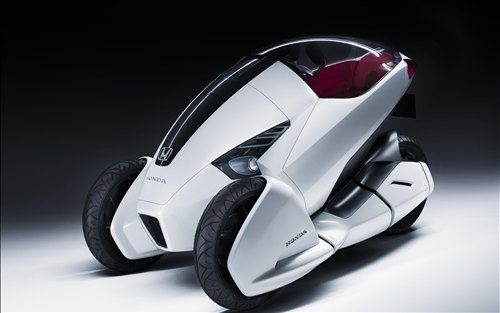
Fortunately for this piece, VW have recently had another go, and I like the look of this version a lot better. Firstly the looks are much improved. They haven't gone for a noisy, rough, stinking pollutin' diesel engine either: this is an electric car as you might have guessed. This makes it short range only but you can't have everything I suppose. At the moment it's just a concept but VW is working hard to get something like it into production in th near future. It probably won't be as nice as the concept, purely for price point reasons of course, but they will be putting something small and electric on the market in the next few years. I do believe there is a market for something this size with a small petrol engine though.

Ah, now, you see, three wheels doesn't cut it. Got that? Doesn't matter if they do tilt in a cool way. The centre of gravity is just too high. Build a proper chassis please, and put away the childish tilting. This is 2011, flying cars are only 4 years away and we have barely got the car safe and efficient for road travel, never mind flying. Go design a new hatchback or something.

Now that we've seen some of the ideas the motoring world has produced, here's my idea:
4 wheels, each driven by its own electric motor. A small petrol engine or gas turbine at the back for range extension, with a good sized fuel tank; this drives an alternator which feeds power to a small bank of batteries and the wheels. The batteries are kept at a constant charge of no less than 50%, thus extending the lifespan of these expensive components. When braking and hill descending the batteries are allowed to charge to maximum extent. All electrical motors and alternator and batteries are water cooled to make them lighter and more efficient. Chassis should be an aluminium monocoque or aluminium/composite. Finally the passenger cabin should have one chair, for larger versions perhaps two. All of this would mave for an efficient, light, relatively fast little car. Only one obstacle remains: cost. I suggest that road tax for single seater or dual seater vehivles be lowered. That would help with the barriers of entry and get more people into them in the first place.

Saturday, 22 October 2011

Just another charity. Not (a charity).

Got a call today from someone on behalf of Bowel Cancer Australia. Now I am a great fan of charitable donations, but I have recently become more aware of the sorts of things that go on in the world, so I approached this with some skepticism. Firstly I suspect that "on behalf of" means he doesn't actually work or volunteer for BCA, but I forgot to ask. At least he did say that it was not a solicited call and they were calling everyone in my area, so I decided to hear him out. Got the usual spiel that you get from all of these charity calls. The good work they do, the terrible nature of the things they're working against, and then please select which amount you would like to contribute. Ah. So no question about whether I'd like to contribute, only options that involve me giving them money.

I ignored the question and asked if they have some sort of income statement so I can inspect their finances and so on. Meanwhile I navigated to their website to see if I could find such a document. My search came up empty. He said they used to send that stuff out but not any more, to save money. He again gave me all the different donation options, none of which were "$0". They receive no ongoing government funding. OK so, apparently they have received some money from the government. And they lobby the government to send out more free bowel cancer testing kits to everyone over 50. At this time I again asked about the finances so I was bounced up to the supervisor, because the guy I'd been talking to was on his first day.

The supervisor informed me that they fund research into bowel cancer, lobby the government for more free testing kits to be sent out, and provide support services for people with bowel cancer. How much do these testing kits cost, which are available in pharmacies? $36. Now the question on my mind was, why not simply get GPs to get their patients to buy these kits if they are over 50? $36 really isn't a huge expense, and it's only once a year. I didn't voice that particular opinion, though. I next asked where the government gets these kits they say should be distributed free. He didn't know. I was suspecting that they might be the manufacturer and so getting the government to send out more kits would make them money. Cynical, I know, but you have to be sure. "Don't they just get them from the manufacturer?" Again, he didn't know, but he did offer to send the information out to me.

That was the most I could get from them at that time. I look forward to reading the email to find out if they would be a worthy recipient of my money, but given that they are lobbying the government to spend tax money providing free kits, I strongly suspect I will not be moved by their cause. Perhaps if they instead used their income to buy kits and send them free of charge to people over 50 who are on very low incomes or in some other way would not be able to buy the kits themselves, and sending letters to GPs informing them of the benefits to their patients and getting the patients to buy the kits themselves, then I might consider sending them a few bucks. But the fact that they consider it a good use of their donors' money to lobby the government to spend other people's money makes me ... er ... not like them very much. At all. Sort of the opposite, really.

Friday, 7 October 2011

The answer is more tax. What was the question again?

Two recent stories reported through various media no doubt, but read by me on the Conversation's website, have made me near apoplectic. The first is a report on the recent tax forum and the second concerns some ideas on a junk food tax for Australia. The latter is of course at least partly catalysed by Denmark's new "fat tax".

Let me deal with the fat tax first. The suggestion he makes is for a rather broader junk food tax:

If we want a tax that’s going to be effective in reducing obesity in the longer term, we need a broader approach to taxing unhealthy foods rather than just measuring the fat content.

We need to consider the salt, sugar and fat content, along with an assessment of the benefits of nutrients such as fibre, and fruit and vegetable content.

Put all of this information together and you’ll get an assessment of the overall healthiness of the food. A tax should be applied on this basis, not just the saturated fat content.

In other words, Denmark's tax does not go far enough. Well I'm glad we sorted that out. I was beginning to think you might only say that it was going too far by also taxing butter and oil. Silly me.

As usual no one is asking whether it is wise to give the government more central control of the food supply, or whether it is democratic to interfere in the market, or whether it is the government's responsibility to change people's lifestyles. In other words, no one is even considering whether liberty might be more important than the obesity epidemic. It's not even on their minds. A poll from two years ago showed that 64% or so of Australians would support such a tax, while apparently only 16% would strongly oppose it. At root this seems to be at least in part due to the transfer of responsibility away from the individual. By extension the responsibility is transferred to society, especially the government. Thus if there is a problem in society, it is because the government is not doing enough. No one ever considers whether the government should do anything at all, or whether it is doing too much.

So you tax the foods that are high in sugar, fat and salt, and you use the revenue that’s generated to subsidise fruit and vegetables and some other healthy foods.

This would create more of an incentive for people to not only stop eating the unhealthy food but also choose the healthier foods.

You only incentivise the poor, because the middle class and above have so much money that only rediculous tax hikes will deter them from buying anything they really want and could otherwise afford. Unfortunately, junk foods are not as elastic as they think because they are highly preferred, so people will give up other things in order to buy them, rather than decreasing consumption to save money. The nett effect of such a scheme, then, as I see it, would be to siphon money from the poor, who may have few pleasures in life apart from food, and give it to the rich - who could have afforded the vegetables anyway and would buy them anyway because they can compensate for a boring diet (not that they necessarily have one) by buying more expensive things that give them pleasure instead. So once again the star economists have proven that they have no idea how people work. They think you just have to nudge them in the right direction by giving them a little hit to the wallet, but this will have no effect if people value the item more than you're taxing it. People drink coke because it is nice, not because it is cheap. The fact that it's cheap just means that the marginal fans might buy it. The hard-core fans will still buy it in nearly the same quantities if you treble the price. Everyone else will switch to an alternative they prefer, but that alternative will still be a sweet cold drink.
There is also a lot of evidence from other public health measures, such as tobacco and alcohol, which shows when you increase the price of goods through a tax, consumption clearly decreases.
As I was saying, the hard-core don't stop buying it, only people who could take it or leave it.
We also need to consider other interventions such as restricting the marketing of unhealthy foods, improving food labelling (with a simple traffic light labelling system), and implementing public education campaigns, among other things.
Tobacco, 40 years ago. We need to restrict advertising, especially to children. We need health warnings. We need education campaigns. Well actually due to the "education" campaign that has already been waged for so long, everyone already knows junk foods are bad for you and contribute to obesity. Some people haven't responded by stopping consumption of them, so instead of telling them how bad it is we now have to coerce them to stop consumption. The assumption here is that the poor bastards still eating this stuff are so stupid, ignorant or hedonistic that the only thing they'll respond to is a price signal. The sheer paternalistic, condescending smugness of it makes me sick.

Won’t consumers always buy junk food, even if it’s more costly and clearly unhealthy?

The focus of all of these measures is to make it easier for people to make healthy choices.

These interventions aren’t about saying to people, “you can’t eat this and you have to eat that”. They’re about creating incentives and making the environment just that little bit easier for people to make the healthier choices.

Our modelling clearly shows that putting a tax on unhealthy foods and subsidising fruit and vegetables would end up making the population a lot healthier in the long term.

Importantly, it would have higher benefits for people in lower socioeconomic groups who are disproportionately affected by obesity and many other health issues.

Or conversely, to make it harder for them to make unhealthy choices, right? Unless all the tax revenue is spent making healthier food cheaper, all this will do is raise the general price level of food and make life for the poor just that little bit worse. And we know from experience that governments are incapable of earmarking funds. All your taxes just go into a general pool of money whose sole purpose is to buy more low income voters (because they're the most common type, thanks to the huge tax burden) by increasing welfare payments or other subsidies. GST is not earmarked for economic incentives, income tax is not earmarked for income protection, petroleum excise is not earmarked for transport infrastructure. Junk food tax would not be spent only on making healthy food cheaper, it would give the government an excuse to increase their anti-junk food education campaigns in order to enable them to raise the tax some more, and the rest would just go to the treasury.
He admits that poor people buy this stuff more. Isn't anyone but me going to join the dots and see that this tax is logically going to be mostly on poor people? Is it going to make the population healthier in the long term by enabling more rich people to eat veggies for cheap and forcing the poor to eat rice instead? How can you increase someone's quality of life by taking more of their money? How about if we acknowledge that poor people buy this stuff because they don't have money for more genteel pleasures? How about if we increased the tax free threshold so they could afford some more harmless fun?

The commenters are no more enlightened than this egregious proponent of misappropriation.
Says Yolanda Newman:
Personally I want a government which has an interest in me as a whole person. I don't want the government to do everything for me but I do want it to provide things I can't do for myself - like roads and hospitals and then I also want it to be creative about helping me to manage difficult situations - like dealing with food choices.
I really don't think she knows what it means for a government to "take an interest" in a person. Hint: it starts with an arrest.
Damien Gildea has never heard of mission creep:
If government is to have a role in guiding personal nutrition, I would prefer it to be in the form of better education in the basics (calories, additives, basic physiology) so that people are better informed and can indeed make 'healthy choices' rather than having choice diminished through pricing.
Once you start making it the government's responsibility to tell people about a hazard, they will eventually attempt more authoritarian controls of the perceived hazard, including taxing it or banning it. Examples abound.


This is turning out to be one long post. We now turn to the second story: that of the tax forum.

Fortunately I have a lot less to say about this one. Some suggested actions were:
  • Increased capital gains tax
  • Broad land tax
  • More wealth redistribution
  • Eliminating GST exemptions
  • Financial transactions tax (global)
  • No tax exemption for rich women who employ nannies
In other words, we need more of what the government is already doing. Is anyone suggesting that some taxes should be lowered? That maybe the way to help the poor is to tax them less? That maybe we could have more employment if we decreased business income tax? That maybe we'd have more businesses if we didn't punish entrepreneurs for making money? Anyone? It seems all of these academics are just liberal mouthpieces, toeing the government line because that's all they know or because they want more university grants. What about wide ranging debate? What about academic creativity? What about variety of opinion? Can none of these intellectuals outhink me? I seriously doubt that last one. So what does that say about the freedom of thought in academic circles?

Wednesday, 28 September 2011

9/11 Conspiracy Theories

The Americans love a good conspiracy theory. It's been their major export for some decades now, so when the 9/11 attacks occurred the cynical could have placed safe bets on the emergence of a fresh series of conspiracy theories about the events of that terrible day. I'm not going to try to answer all the hair-brained stuff that's come to light from dark corners of the internet - that has been done much more comprehensively and expertly than I could do, but I do want to talk about some of the things the conspiracy theorists have right and wrong.

The origin of conspiracy
I think the conspiracy theories are very significantly influenced by the convenience that the attacks afforded the US government, particularly Dick Chainey. In all times of great tragedy there are those that abuse it for gains in power or status or money, or all of the above. Those that capitalise on the events for personal gain are perfect fodder for the conspiracy theorists' delusions - after all, the gains are great, so they had motive to cause these events. In the case of 9/11 the invasion of Iraq is particularly glaring. To this day I don't know the motivation for doing it. By comparison, invading Afghanistan was perfectly logical (Bin Laden was a Saudi) and a measured response (more than 8000 civilians dead and counting) to the 9/11 attacks. I can only assume that it was galling that in 1991 they couldn't actually invade and they wanted to make up for it, combined with a perceived need for the oil security. If so, it's just about the most expensive oil ever bought, since it has cost at least $3 trillion, which is short to write but it's a truly catastrophic amount of money, and if anything it's a gross underestimate since many fine young men have suffered severe and permanent physical and mental trauma, and of course a fair number have been killed in action.

Leaving aside the legitimacy and pointfullness of the war, though, it's a great "motive" for the 9/11 theorists to cite. Apparently the desire by some to go to war was so extreme that they would go to enormous lengths to make it happen, even orchestrating a terrorist attack. Here follows some conspiracy theories and my generalised rebuttal.

Controlled demolition
For me, this one pretty much takes the cake in terms of implausibility. The American government secretly wired a building in the middle of their greatest city with explosives? The explosives were not set off by the massive shock of a heavy jet hitting them and the resultant jet-fuel fireball? And they worked perfectly, just at the moment the towers were starting to fall?
and someone was watching, waiting for the perfect moment to set them off even though the buildings might easily have collapsed anyway? This gets a full 5/5 flying saucers. There are some outstanding facts that are hard to explain for the "conventional" school (i.e., the buildings came down because they were hit by heavy jets and exposed to extensive, raging fires) but 9/11 is a unique event, so there are bound to be some facts that are hard to understand. A mysterious fountain of sparks that looks suspiciously like thermite is one example. Unfortunately quite a few "experts" have gone on record as saying that it was controlled demolition. I'm all for academic freedom, but these guys are missing a trick: THE BUILDINGS WERE HIT BY HEAVY JETS. Stress concentration is one thing I see not mentioned by any structural or materials engineer who goes for the controlled demolition theory. When combined with fire, it's obvious to me why these buildings failed while no other steel structure has ever collapsed due to fire. A significant amount of the supporting structure had been wiped out asymmetrically. This would seem to cause a torque on the whole building around where the plane hit, and combined with the effect of heat lowering the yield stress of steel ... like I said, obvious.

Aircraft autopiloted into WTC

This is as daft possibly even dafter than the one above. The terrorists were in the cockpit. They had taken flying lessons. We have lots of documentary evidence for both of those facts. So why is it that someone would insist the planes were guided into the WTC by their autopilots which had been remote programmed? I'm not saying this is impossible, but on a scale of 1 to 5 UFOs it gets 4.5 for sheer brain shutdown.

United 93 was quickly removed/shot down by missile
This is one the conspiracy theorists have right. The wreckage from United 93 was removed very fast - at the moment of impact, in fact. By an enormous jet fuel fireball. The circumstances of its crash were unlike most aircraft crashes. Most aircraft crashes that happen on land are what you might call a severely botched landing. The pilots try to land or mitigate the crash so lose altitude slowly if possible and come in parallel to the ground. Tragically, the evident struggle in the cockpit of that plane caused the controls to be manipulated in such a way that the plane made a hard right bank - I'm guessing a rudder hard-over, which would be consistent with someone kicking indescriminately if they were struggling - and then went nose first into the ground. Such an impact is unusual in that there is a lot of force acting directly on the airframe, causing it to shatter into much smaller pieces than normal. The concomitant fireball would send these pieces right out of the park. The sheer number of witness accounts make this one a fairly watertight case so I give it 4.5 crop circles out of five.

In a sense all of these conspiracy theories are the same. It's always the government or "they" - forces within the government - that is doing it to its own people. And in a sense they have it right - all governments do terrible things to their own people, especially in this current age of unprecedented power over their people. But conspiracy theorists also miss the point. Airing conspiracies with house of cards levels of documentation is not going to convince people en masse - indeed, a lot of sites propound a whole swathe of conspiracy theories, some legitimate concerns, and others complete bunkum, and in doing this play into the hands of any forces that genuinley want to keep certain information out of public eye. The best place for a true conspiracy is among half a dosen fakes. That way no one with an ounce of common sense is going to believe any of it. In that way there is conspiracy hegemony: either you believe all the conspiracies (if you have taken leave of your senses) or you believe none. To give serious thought to any conspiracy automatically moves you in to the conspiracy camp and gives your word the same weight as someone who still believes in aliens, so few people would do it.

Conspiracy theorists' credibility problem derives from their ignorance of Ockham's razor and Hanlon's razor. Combine this with sources that themselves are not credible (some have reasonably scientific methods but also point to other conspiracy sites or known conspiracists) and cherry-picking of evidence, and you have total loss of credibility. The only difference between an investigative journalist and a conspiracist is that one is a lot more rigorous. In short, conspiracists suffer from insufficient skepticism and rigor. Until and unless they get their act together there's little chance that any genuinely concerning things they report will ever become known before it's too late to do anything about them.

The other major problem with all of these conspiracy theories is they fail to draw attention to the civil liberties that were considered basic human rights before the attacks but have since been eroded or destroyed. New powers were granted the government, just as new powers were granted Hitler during crises, and these powers were mostly used to repress ordinary citizens, although the rhetoric was about protecting the public from sleeper terrorists and the like.

I always cringed when Bush said something like, "They hate us for our freedoms." From day one I knew that couldn't possibly be true. No one attacks someone else just because they have more liberty. The reasons for the attack are complicated no doubt, but they tend to boil down to a reaction to American imperialism. Speaking of liberty in this way debases it by making it a pretext for treading on the liberties of foreigners in the middle east and the people at home. Governments around the world have proved that Bush's retoric has a place: we the free people can say of most governments that, "They hate us for our freedoms."

Wednesday, 7 September 2011

When you're tired of learning to drive, you're tired of life

After eight years of study in any particular field, it is assumed that you will pretty much be an expert. Even an amateur spending one to two hours a day on something will become extremely knowledgeable in short order. So why is it that most people's driving is so bad? The obvious explanation is that practice does not make perfect unless you have a coach. People drive all the time but since they have no goal for improving their driving it does not significantly improve after they've learned more or less what all the levers do. I see no reason to flatline (haha) my probability of accident so I look into this now and again to refresh myself. One of my favourite sites is Safe Speed which, apart from having a lot of information about why speed cameras are bad, also gives really solid tips for advancing in your driving generally.

The reason I feel called to write upon this most vexing subject is a recent reminder of what happened to a hapless motorist in 2009 when on the motorway his cruise control got stuck on. The police were eventually called in to clear a lane for him while he battled to regain control. What a way to catch a plane if you're running late! Joking aside, I immediately became suspicious of the whole affair because I can think of at least three ways to stop a car with the cruise jammed on. So, in the interests of public safety I will deal with the cruise-jammed-on scenario and then the brakes-have-failed scenario which, let's face it, could actually happen to you. The cruise control episode was pretty much a once off for civilisation as a whole.

Cruise stuck on

1. The brake pedal. Yeah I know it's obvious but would you believe it, he tried the brake pedal and nothing happened! Could this have been because the cruise control will increase throttle to maintain speed? Yeah it's that obvious. So nothing appeared to happen even when vigorously braking. Only when the brake pedal was pressed hard enough to overcome the engine's torque did the car slow down, and in fact this is what ultimately brought the episode to an end.

. The clutch pedal. OK I know most people drive automatics these days, but there are manuals with cruise and it would be easy to just declutch to prevent drive from going to the wheels. And speaking of which ...

3. Neutral/park. Most automatic gearboxes are still in control of the driver. You can change down or perhaps even to neutral. Worst case scenario is the engine revs a little too high but that's what you have a limiter for.

4. Ignition. Turn it off. The report says he tried this but it wouldn't work. It is clear, however, that he was so incoherent with panic that the obvious things I've mentioned didn't occur to him, or when he tried them they appeared not to work. Still, a really easy solution to cruise getting away from you.

5. Handbrake. Won't work, not by itself. The main brakes on a car are easily capable of countering the engine, especially in top gear, but the handbrake cannot. Don't try it unless there is literally no other option but to die.

No brakes

1. Most important thing here is not to panic. I don't mean to be confronting, but in emergencies panickers die.

2. You'll want to remove drive, so let off the accelerator, duh. Further steps you can take to slow down faster are to gear down as much as physically possible. This is particularly essential if the failure happens on a downhill slope. Do not put the car in neutral, that will perevent engine braking.

3. Brake failures are various. Try pumping the pedal, applying both feet. Sometimes the brakes will be cooked, meaning they are less effective because they've overheated. Worst is if the brakes have failed completely, leaving your only stopping power with the engine and handbrake. Speaking of which ...

4. Do not yank the handbrake. You will lock up the rear tyres and spin right into a fireball. There won't even be anything left to bury. Gradually apply pressure and if you feel the rear of the car letting go, release the handbrake. Hence, keep your thumb on the button or you may panic and just let go, leaving it ratcheted up.

5. If none of the above will stop you, hard cornering can also slow you down but again you have to limit yourself to the handling envelope.

6. Drive up a hill. Simple and obvious. Don't make the mistake of getting to a stop then rolling back down again. As you come to a stop, turn across the hill so your car is no longer on a slope in the direction of roll.

7. Run off the road. In rural areas this one will be obvious, but then maybe you'd have enough road to coast to a gentle stop, whatever. A handy field full of soggy grass will slow you down a treat, as would sand for those times when your brakes fail next to the beach.

8. Depending on the situation, you may be forced to crash into something. If that is the case, after having done all the above to slow as much as possible, select a hedge, a stand of saplings, perhaps even another car, to rapidly wash off the rest of your speed. You can even select quite solid obstacles as long as you're doing less than 40 km/h. If a tree is the only thing suitable, use the tree, but try not to hit it head on unless you have passengers. You can slow the impact by striking it with the far corner of the car, thus converting some of your forward momentum into angular momentum. Obiously don't do that if you would then career off a cliff.

9. You thought crashing was the last ditch, right? Actually if you have enough space you can try something even more dangerous - a spin. This is also the only remaining option if you're going too fast to crash safely. Use the handbrake to lock the rear wheels, then violently turn the wheel to induce a spin. This will be similar to attempting a fully locked up stop. Keep the steering wheel at full lock until you've slowed down enough, otherwise you may end up going backwards into whatever you were trying to avoid. The reason this is more dangerous than crashing is because you cannot control it - you may crash into something driver door first.


So there you have it. What to do if your brakes one day decide to give up the ghost when you need them most. Once again there is an obvious point on which to close: an ounce of prevention is worth The Monster Bomb of cures. Proper maintenance is the first part of safety. Other than that, don't overheat your brakes on a long downhill - use pulsed braking (also known as not riding the brakes) and engine braking. Got that?

Saturday, 3 September 2011

In reply to the Angry Exile

The recent proposals of one Nadine Dorries is causing some action on the blogosphere and naturally because the issue is abortion it is quite a divisive one. It seems the general libertarian thought on abortion leans towards pro-choice rather than pro-life. I commented on the Angry Exile's blog that I found this incongruous because it is promoting the liberty of one at the expense of another's life. In response he wrote a fairly epic post about his thoughts on the matter and I thought I might as well reply here rather than post a really long comment. This is naturally a very emotional topic, but I'm going to try to be objective and dispassionate because although passion is important and useful in persuasion, the abortion debate has had been rich in passion but not as rich in objective criticism.

Imagining for the moment that there were no abortion laws and assuming that the woman’s own life was not in danger and that it was simply a lifestyle choice to abort very late – say 35 weeks or so – it’d be hard to see it as anything other than murder for one's own gain, arguably the most severe and permanent infringement of an individual's liberty that there is. However, at the other end of the process – around the time a morning after pill is used, for instance – it may be no more preventing a small number of undifferentiated cells from plugging themselves into the uterine wall in about a week's time.
This is the point where my views begin to diverge from his. I agree that late stage abortion has no real difference from killing a newborn, but I seriously question the assertion that the fertilised ovum is anything other than a unique human being with their own life that cannot be justly brought to an end.
At one end there is definitely a someone, and like any other someone objectively his or her life has value. At the other end is a something, and while it’s something I’d value almost as much I can’t deny that that’s subjective. In between those two extremes is a large area that's increasingly grey around the middle.
This grey area is almost at the heart of the matter. The real problem here is continuity. Where is the point between embryo and baby where you can definitely say that is where the transition occurred? Is it when the first brain cell develops? The first heartbeat? Something that is "looking human"? I have come to the conclusion that this question has no meaning. There is no definable point between embryo and baby where you can say, right, from this moment forward we have a human being. Do you want a simple and categorical change in the nature of the being? Well, I can point to one: conception. At conception we go from being two haploid cells with no innate ability to divide and live to a single diploid cell with utterly unique DNA and, assuming conception did not occur in vitro and notwithstanding unlucky circumstance, the potential to grow into an adult human.
And here we run into another problem - most become nothing at all. Though I first learned this at school I’m not sure it’s widely known, but the majority of pregnancies fail and the majority of those that fail will fail early, i.e. in the first trimester. ... So it seems hard to assume that very early embryos/pre-embryos have rights to the uterus because of what they may become when sadly it's quite likely that they'll become a slightly heavier than normal menstrual flow and perhaps worse than usual cramps.
This is informative but it doesn't really affect the issue. Percentage chance of continuing life is no measure of the value of a life. In earlier centruries it was common for more than 50% of your children to die before adulthood. I don't think any sane person would venture to suggest that gave the parents decisional right to whether to raise them or not.
We can go further still and consider that those cells are almost entirely the woman’s own material except for the tiny component which is the single sperm that got into the ovum, and anyone who’s ever finished off a round of horizontal tango and found that the condom broke will know that that sperm cell may not necessarily have had an invite.
Once again, I have to say this does not fundamentally affect the issue. Any human is home to far more bacteria than their own cells, as is every full grown foetus no match for the number of cells of the woman carrying it. For these reasons I don't consider the situation of the newly fertilised egg to have any bearing on its uniqueness or life.
... do those cells get rights because the woman willingly took part in an enjoyable activity which admitted other cells into her body, one of which resulted in her becoming pregnant? It's tempting to think active participation makes it so ...
Very tempting - in fact I believe it does. Any sexual encounter is associated with a probability of pregnancy occurring as a result, except of course for those who are infertile for any reason. No matter how many measures of contraception are used they may all fail. Everyone who consents to intercourse knows this, and therefore accepts that pregnancy is a possible outcome. I'm not sure many people know this but that is the fundamental reason for laws regarding consent. I don't mean to discount the psychological damage that can happen when there is no consent (rape, in case you missed it), but at their heart the laws of consent recognise that both parties have a responsibility for the results of their actions, and one possible result is pregnancy. To accept the possibility of pregnancy at first and then turn and claim that the pregnancy is unwanted is foolhardy. If pregnancy is to be avoided, sex must be avoided.
Libertarianism, at least the way I see it, is both freedom and responsibility. The choice to end a pregnancy, whatever my personal feelings on the matter, is about a woman’s freedom and ownership of her own body to begin with and, if she doesn’t want to be pregnant, about her responsibility to exercise her choice long before the stage at which she’s also responsible for a human life within her.
Libertarians are fond of returning responsibility to the individual. I am taking that to its logical end - if two people consent to having sex they must both be willing to accept and care for a child that may result. That means abortion is not an option, at the very least not as after-the-fact contraception.

That's all I want to say for now about the reasons why I believe that in general abortion is not to be considered as after-the-fact contraception. I am going to venture from the sure foundation of logic and reason into the trecherous territory of morality and ethics.

Consider a hypothetical situation: let's say a woman has a loving husband, has the means to support a child, and wants to have a child. Would she get an abortion? I ask because it seems obvious but I don't know whether people recognise that if all women who were "sexually active" were in that situation, abortion would not be necessary. From what I've gathered over the years most women who resort to abortion are not just ice queens who have no regard for the life of their own children. It is typically the type of action to which one is driven by circumstance - like stealing food if you are about to starve. Shame, avoiding an "honour killing", the will of the father, these things are real and serious social issues and I can well understand the mind of someone who is driven to abort a child because they would suffer great persecution, even death, if people found out.

So I am not saying that I don't have sympathy for women who have ended up in these very difficult situations. In nearly all cases though, if abortion is the cure, the disease is preferable.

Not that I am calling pregnancy a disease, you understand. In fact, the acceptance of abortion in our culture is, I strongly believe, in part resultant from the change in how children are seen. In the past children were seen as a blessing, a gift. In modern times it seems a lot of people view them as a financial burden that restricts your own freedom to travel or do whatever. The very concept of an unwanted pregnancy is partially resultant from this view which is tremendously damaging to society. Think of my hypothetical situation before: the woman wants a child and has the means to bring one into the world, so why would she even consider aborting?

Another reason for the prevalence of abortion in our society is the prevalence of those conditions that will put women in these very difficult situations. "Casual" sex, particularly, can be blamed here, but so can all sex that happens outside marriage generally. Would a woman have shame for getting pregnant when she's married to the father? Would her male partner demand an abortion if they are financially stable and they both want a child?

Those extremely difficult situations that lead a woman to consider abortion are nearly all avoidable. You cannot get pregnant if you do not have sex (don't comment about IVF - I know and so do you, and you know I know). Abstinence is simple and obvious, but it's not easy. I may write further on that topic in the future.