Showing posts with label hybrid. Show all posts

Saturday, 17 December 2011

A little something about fuel economy.

Here's a simple question: which of the three pedals you see above is responsible for the most wasted fuel?

If you answered "accelerator", I have some bad news. It's not the accelerator, it's the brake pedal.

To find out why, we need to consider what goes on when you're driving along, and what the purpose of the accelerator and the brake are. The clutch pedal can be safely left out of the discussion for now, although it does have its own uses and misuses.
Most cars weigh something between 1000 kg (a tiny hatchback) and 2700 kg (an enormous 4x4). For the purpose of this illustration I'll deal with a 1700kg car. At 60 km/h this car will have about 470 kJ of kinetic energy. When accelerating to 60 km/h all of that energy has to come from the engine, and when you stop it has to go back in to the engine (engine braking), into the brake pads and discs, and to friction losses (drag, tyre rolling resistance, drive train losses). As it turns out, which of those three mechanisms you predominantly use to dispose of the energy is extremely important with regards to fuel economy.

How you accelerate does have some importance, of course. If you are willing to accelerate more slowly you can save fuel by changing up earlier. This reduces energy losses innate to all piston engines, that is, the back-and-forth motion gets faster and this constant change in direction causes some power to be lost. So even though two people might both end up at 60 km/h, with identical cars, the one that accelerated more slowly would have used less fuel over all, simply because less was wasted in gaining the speed. If both had perfectly efficient engines the slow accelerator would still be slightly ahead (on economy) because he had a lower average velocity, but of course the redneck would get home first.
At constant speed, all other factors being equal, they use the same amount of fuel because they have the same drag to overcome. At constant speed this is the only factor directly related to speed that chews through your fuel. This particular consumption is proportional to the square of velocity, so going a little bit faster actually adds quite a lot of wind resistance (double your speed, say from 30 to 60, and you quadruple the air resistance).

Now we come to the brake pedal.

When you apply the brakes, some of your kinetic energy is converted into heat, and is lost to the atmosphere. Heavy cars need to have big brakes, because these have both more friction to slow the car, and lose heat more quickly so they don't get too hot. It is possible to overheat most types of brakes if you use them a lot in a short space of time, such as slowing from high speed on a steep downhill, or driving around a track. This will cause their friction to decrease and they won't be able to slow the car as efficiently, leading, sometimes, to a crash. That aside, the important point here is that two people, one a redneck thrashing his car, and one a gentle old granny accelerating to 60 km/h in 30 seconds, have identical kinetic energy, all things being equal. So if they both push the brake pedal to come to a stop, both are wasting all the energy they used to get up to speed. All of that energy came out of the fuel in one way or another, so effectively they have both wasted all of that fuel.

Having realised this, what can be done? How can we waste less energy, or even better, recover some of it? The first part, wasting less energy, is possible in any type of car, and it has little to do with how hard you pushed the accelerator 4km ago. The main thing is to take some of the energy that might have been going into the brakes and place it somewhere where it can do something useful, sich as keeping you going along a little way. Most obviously, this means coasting. In gear or out, coasting will be converting some of the kinetic energy into that which is overcoming the drag of the car. You still lose the energy irrevocably, but it is at least keeping you going rather than being converted straight to useless heat. If you are in gear, you also have engine braking going on. This means that the energy the engine would normally need to turn over at the given revs is coming not from fuel but from the kinetic energy of the car or, on a downhill, from the gravitational potential energy as well or instead.
Recovering the energy completely is impossible, but partly, yes, that can be done. If you watch Formula 1 you may know of a system that was used a few years ago: KERS (kinetic energy recovery system). This is a system that uses an electric motor/generator to save some energy when the car slows and spend it out again for a quick burst when the driver wants to overtake another competitor. This type of system is perfectly feasible in a normal car providing that it has an electric motor and battery/capacitor to store the energy. As such, pure electric cars almost always have a system like this, and so do hybrids such as the Toyota Prius, usually called regenerative braking. In an ordinary car (that is, not F1) such a system is very helpful in stop/start traffic, because you can save some of the energy you used to brake and put it to use accelerating again. Slow moving traffic is notoriously wasteful purely because you have to stop and start again so much and hybrid/electric technology helps reduce this energy loss.

Ultimately, the most efficient way to travel will always be at constant speed in top gear, which is why you get much better economy in the country and on freeways than in traffic, even though the drag losses are much greater, but you can get close to that by being gentler in acceleration and braking, and as a result, you'll be safer too. Start slowing down a fair way before a junction or red light. Give the car in front a bit more room, especially if a car behind you is on your bumper. Use both brake pedal and accelerator gently. All of these things will make you a safer driver, and in all likelihood will get you home faster too, since arriving at a light when it is green at 20km/h will put you ahead of anyone who races up to it, stops, and then has to get going again. Hopefully you will have fewer accidents too, which means lower insurance premiums and less hassle. You may also arrive at your destination more relaxed. What's not to like?

Friday, 9 December 2011

Someone took my advice ... before I gave it.

Perhaps if I'd had the presence of mind to do a little more research before penning my post on what we need in cars, I'd have seen this example of a company thinking ahead:
We simply took a standard BMW Mini One, discarded the engine, the disc brakes, the wheels, and the gearbox. These components were replaced by four of our electric wheels, a lithium polymer battery, a large ultra capacitor, a very small ICE with generator (so small it almost fits alongside the spare wheel), an energy management system and a sexy in-car display module.
As you may remember my conception was that there should be one electric motor per wheel, no mechanical drivetrain, with power reservoir in the form of a battery. I did not consider the importance of supercapacitors in acting as a very short term rapid power sink and source.

Perhaps this is the time to mention a few things about the piston engine used in most cars and trucks. Its problem is that it isn't a very good machine for driving cars and trucks. That's why there are clutches and gearboxes, so that we can maintain driving conditions within the power band and not stray too near the 0 torque of 0 RPM. Furthermore, to provide the acceleration we desire they have to have a lot of power left in reserve, rarely used, and this makes them large and heavy. Electric motors have none of these drawbacks. They have plenty of torque from 0 RPM and can rev much faster than is usual for petrol engines. As such they can drive a car from stationary right up to a very reasonable top speed usually governed only by the rev limit. The only problem with them is that, obviously, the electricity has to come from somewhere. Trains and trams can receive power directly from the grid, but cars trucks and motorbikes will not be fettered by centralised power distribution. Therefore they must store electricity in some sort of battery or have on board electrical generation. Hydrogen fuel cell technology creates electrical power directly from the fuel, but it is also possible to use the old fashioned piston engine to generate power via a typical magnet and coil generator. Given the difficulty of storing hydrogen, and the expense of its componentry, and the fact that the petrol engine is here now and has the benefit of a hundred years of research and development and the monumental pile of research cash flow it has experienced due to the sheer number of cars produced, I believe it is the right tool for the job. Turbine engines would be more efficient in every way, but they are significantly more costly and given the expense already represented by the necessary electronics it seems to me that turbine powered consumer vehicles are perhaps beyond the reach of the average man.

The Mini mentioned in the story has a 250cc two-stroke engine, which seems odd since they're trying to prove that you can use this technology to save the environment and two-stroke engines have very dirty emissions. This does follow the principle, though, that you use a classical internal combustion engine to extend the range of an electric car, given that batteries do not yet provide the range of a petrol tank. I firmly believe that they never will. It will always take longer to recharge a battery than fill up a tank of petrol or diesel or, perhaps, one day hydrogen. We will never be able to store enough energy in them to consider pure battery power as an energy store for consumer vehicles, especially those that drive all the time, like trucks and vans. Some form of fuel will always be necessary; to think otherwise is silly. Removing and replacing batteries at some sort of battery swap station is also silly. That's going backward in techonological terms. When horses were all we had you had to change them when they were worn out, now they are talking of doing the same with batteries? How stupid. The average man will never go for it, so it will fail, no doubt in my mind about that.

So until the fuel cell becomes a cheap enough power source, we will be left with some sort of petrol- or diesel-electric system, and that is fine with me.

Monday, 21 November 2011

We need a new type of car.

The title says it all, really. I've identified a gap in the motoring psyche that no manufacturer has successfully filled, at least here in Australia. Briefly, there is a problem with most cars on the market today. This is not about CO2, at least not directly - you see, modern cars are far too big and heavy.

Now I do admit, there are some seriously good advantages to this. Big, heavy cars these days are very well built, making them as comfortable to crash into a concrete pylon as laying down on a feather mattress. They also have a lot of space for passengers and luggage, and there's plenty of gadgets to entertain both driver and passenger. There is a place for these cars, yes. I like big, comfortable cars. But I also like small, nimble cars and it's here that manufacters have been forced, by consumers mind you, to be conservative. Even the tiniest hatchback has four seats (for mice, if you want actual humans you really do need a normally sized car, like a Focus). This obsession with seats got me thinking, why do we need them all?

Most of the time, you see, people are only driving themselves. Granted this is probably not the case with families and mum driving the kids to school and various extracurricular goodness, but by and large the commute is conducted solitary. So why do you need four seats? Much of the extra weight that cars carry these days is due to the size of the passenger cabin. If you could trim it down to one seat, with maybe a bit of a shelf for your briefcase, you lose nothing in the usefulness of the car for that particular purpose, and gain in many ways - lower cost of pruduction and of course less fuel are the obvious ones. The economics are fairly sound. You do lose some safety factors of course, but then on the commute you are not travelling at high speed most of the time, and if lots of people did this then collisions would be almost as safe as if everyone drove tanks. Why is the market not cryinge oute for this?

Well, with the theory in hand, let's have a look at some attempts over the last few years to create my vision of the perfect commuter's car.

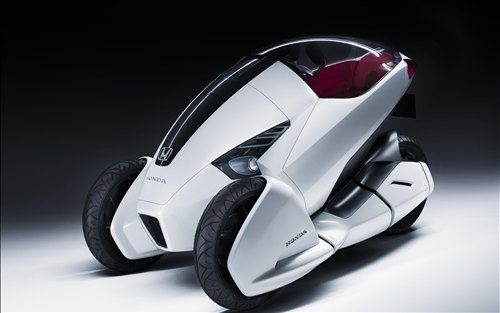
This yellow electric car gets the concept just fine: a small car only for commutes, usually short distance. But where to begin. Today's car has to look good, and I'm afraid it's total failure for this one. Moreover, I really don't think three wheels is the way of the future. Stability is compromised.

Mmm, this looks nice, but I think that cabin would feel rather a lot like a coffin. Plus we're back to three wheels again. What was the allure of that to begin with? And of course there are any number of similar concepts.

Ah, now that's more like it. The Carver solves the stability issues of 3 wheels by tilting, which is very cool, but the complex engineering involved also makes it quite expensive. Why not just add a fourth wheel? Just a thought ...

VW developed the idea quite a ways in a 2002 concept car (right), and it really showed some of the advantages: 290kg weight would have made it insanely efficient. Unfortunately it was given a 1 cylinder diesel engine with no power so it was never going to go mainstream, and of course it was extremely ugly. I say again, for mass market appeal it has to look good and have a decent engine. 50 kW would get a 500 kg car going quite nicely, potentially as fast as 0-100 in 8 seconds which is right in the sweet spot for a nicely powered family car.

Fortunately for this piece, VW have recently had another go, and I like the look of this version a lot better. Firstly the looks are much improved. They haven't gone for a noisy, rough, stinking pollutin' diesel engine either: this is an electric car as you might have guessed. This makes it short range only but you can't have everything I suppose. At the moment it's just a concept but VW is working hard to get something like it into production in th near future. It probably won't be as nice as the concept, purely for price point reasons of course, but they will be putting something small and electric on the market in the next few years. I do believe there is a market for something this size with a small petrol engine though.

Ah, now, you see, three wheels doesn't cut it. Got that? Doesn't matter if they do tilt in a cool way. The centre of gravity is just too high. Build a proper chassis please, and put away the childish tilting. This is 2011, flying cars are only 4 years away and we have barely got the car safe and efficient for road travel, never mind flying. Go design a new hatchback or something.

Now that we've seen some of the ideas the motoring world has produced, here's my idea:
4 wheels, each driven by its own electric motor. A small petrol engine or gas turbine at the back for range extension, with a good sized fuel tank; this drives an alternator which feeds power to a small bank of batteries and the wheels. The batteries are kept at a constant charge of no less than 50%, thus extending the lifespan of these expensive components. When braking and hill descending the batteries are allowed to charge to maximum extent. All electrical motors and alternator and batteries are water cooled to make them lighter and more efficient. Chassis should be an aluminium monocoque or aluminium/composite. Finally the passenger cabin should have one chair, for larger versions perhaps two. All of this would mave for an efficient, light, relatively fast little car. Only one obstacle remains: cost. I suggest that road tax for single seater or dual seater vehivles be lowered. That would help with the barriers of entry and get more people into them in the first place.