Wednesday, 22 February 2012

Can we get rid of Money?

No.


But in case you want more detail than that, let me start at the beginning: a site which has disappointed me far more than it promised: the conversation, specifically an article published yesterday about the possibilities of living in a Money-free society. I think I am just going to have to Fisk it. Full marks for being non-mainstream (I'm totally joking, this is fairly mainstream now: capitalism is what is on the margin these days), but I'm not convinced.
But the ten contributors to a new book I co-edited, Life Without Money: Building Fair and Sustainable Economies, offer strong, radical responses to defenders of capitalism and the so-called “free world”. They set out money-free models of community-based governance and collective sufficiency, arguing that production for trade contorts and destroys humane and natural values.
'Radical' and 'strong' responses, good, we need ideas. 'So called "free world"', good, we are definitely not in one nor is virtually anyone on the planet. OK money-free governance. Where to start, really. Firstly for the whole of human history the rise of civilised society has always been associated with the rise of money. We have been scrambling for a good form of it since, well, forever. The minute you want to stop growing wheat and start doing something else and trade that for your grain, you need money to know what things are worth and whether you're getting a good bargain. Production for trade creates peace, because it's cheaper to trade than to sieze - it's a better use of your time. Production for trade improves quality because all things are produced by experts, except the very cheapest, and even with them experts have helped make them as cheap as possible. Production for trade improves efficiency because everything has value.
They offer strategies for undercutting capitalism by refusing to deal in money, arguing that we need to replace monetary values and relationships by accounting directly in social and environmental values.
How do we know what these hypothetical values are, and how much value should be assigned? The price system automatically values things according to their scarcity, utility and so on - who is in charge of valuation in this money free society?
... capitalists and workers alike fear more and worse instability in global financial markets.
Ahhh yes, I do agree with that. Financial instability is a serious problem, and one that didn't exist when the market was allowed to provide money. Now that money is created on the whim of politicians and bankers, the market has little say on its production. That uncertainty alone is worth noting, but fractional reserve banking has done far more to ruin the market than any mere currency manipulation. By periodically expanding then contracting the money supply, fractional reserve banking gives rise to the business cycle, in other words it causes recessions. So they do have a bit of a point about this money system being no good, but I maintain that even with its evils it is billions of times better than having no money at all.

Even those of us who are not managers or workers are intimately integrated into the monetary system; everyone’s fortunes depend on satiating Mammon.

For the wealthy north, overconsumption is a very real sustainability-cum-economic challenge: if everyone decided to live modestly capitalism would disintegrate. Growth is capitalism’s achilles’ heel. While overconsumption in the north demands that we develop less materialistic ways of living, it is simply impossible to imagine either individual entrepreneurs or national GDP “degrowing” without a planned economy, at which point we have only two options.

That's not in fact true. People's fortunes depend on satiatin other people! Isn't that wonderful? A person's earnings are commensurate with how well they serve other people. There are exceptions of course, but this is the rule. What exactly is overconsumption? Throwing away newly made LCD TVs? Yeah, but no one does that. Built into the term overconsumption is an ideology that believes there can be too much wealth, that people can be too prosperous. That is simply false. There is no such thing as being too wealthy, there is only being too poor. Too poor to live. Everything above that level is wealth beyond the dreams of the 100 billions who have gone before us.

Materialism is another loaded term. We worship stuff. We see an ad, we buy its product. We are mindless consumers, endlessly throwing away our old stuff when we see the new. No one in the real world acts like that all the time. Do you? Are you therefore the only thinking person in the world where everyone else is a mindless spendaholic? Some people act like that some of the time about some things, but usually it is impossible for a product to become really popular unless it is really good. Consumers demand quality and they demand it cheap. They don't demand something that needs to be replaced every five minutes, and if a company tries to sell it to them they will fail.

Yes, we have a lot of stuff and yes, it's a lot more than many people have, but the fact that they don't have it is not our fault, and certainly not because we have stolen their reseources and there's nothing left for them. Africa is awash with natural resources, so is South America, Asia, the middle east. They have more stuff than they know how to use, but aren't as wealthy as us. The reason for that is simply that we have had a better currency system for longer, meaning we have had greater division of labour and therefore better experts making better stuff for cheaper, for hundreds of years, but most especially the last couple of centuries. Money makes us wealthy.

There's more. If everyone decided to live modestly there would be no significant difference. People would work, producing much higher quality goods that would be much more expensive. That's pretty much it. It does rather depend on your definition of modestly. If you mean giving stuff away then no, not everyone can do it or you're back to where you started. If you mean saving more and investing that will only grow the economy faster. If you simply mean working a lot less then people would find something else to do with their time.
There is the option of state-planned economies, which are out of favour among the left and right alike. The problem with planned economies is working out how everyone gets a say in what is produced. If distribution is more on the basis of need, it would appear money has little function. If we were to have less we would be very concerned to make sure we had enough and the kinds of things we feel we need, or badly want.
Production is not about what we need. We have filled every need by 9:30 AM. If we only produced what we needed we'd go home and, I dunno, probably just have quite a lot of sex all day. Actually, we wouldn't. We'd make other stuff - art, literature, science, travel, philosophy. Humans are made to produce! We produce, non-stop, all day. In the old days all we could do in a day was grow enough food to feed ourselves. Nowadays we can produce vastly more. If you sent everyone home after an hour's work (to pay their food bills), they'd start new companies and create new stuff because people don't like to be idle, they value their time and their labour, and they use it to improve their lives. So what would happen if you stopped people working at work is they'd go home and work. So if everyone's physical needs are met with an hour's labour, what are the rest of the hours for? They meet the needs of other people, and other people in turn meet their needs. How do they know what to do, what people want? The price system. The price system gives everyone a say in what they want, because if they want something they'll exchange some of their hard-earned for it, if not, they won't and no one can make them. That's why it's a free market. There is no other way to efficiently organise an economy, because there are too many variables. By reducing everyone's wants to one signal - the price - money serves the indispensable function of telling people what other people want. An enterprise is profitable if people want what it has, and it fails if they do not. There is no choice but to serve the customer.
On the other hand, non-market forms have the distinct benefit of offering individuals and neighbourhoods economic democracy.
As I was saying, price is the ultimate democracy. What somone is willing to pay for something is their vote. You cannot have prices without money.
But the economic infrastructure of a world in which we could all have a say in how we live our lives is sketched out in the final chapter of Life Without Money, which offers a model of a “compact society”. “Compact” because all the main relationships and structures would be based on legally enforceable voluntary agreements, rather than monetary contracts.
Instead of establishing tiny self-sufficient households, we’d work collectively, with a range of connected local households occupying a basic unit of a neighbourhood, the size of which would be flexible and dependent on the local ecology. Local collective sufficiency would be the key aim of every neighbourhood, sourcing materials for, and making, food, clothing and shelter as well as other basic needs, through appropriate technology.
Wow - by working together people can have more than if each worked by himself! If only we could apply that to the whole world, imagine what we could do! Or rather, forget what we ever though we couldn't do! We could conquer the galaxy! But how can we work together efficiently? I know, let's use something rare and long lasting to trade with. We could strike it into coins and call it - I dunno - Monay ... Monet ... Minno ... Money!! Some people wouldn't even have to farm for a living they could spend all their time inventing cool stuff to make our lives even better!!11@!@!!!!!!ONE
Of course, there are likely to be needs or wants that people could not source or create locally. Ideally, these would be obtained from a neighbouring area or through the least environmentally and socially expensive option available at the time.
Hmm yeah, good idea. Let's trade using a universal system of account. It so happens I already invented a name for it: Money (C) [TM]
Establishing and maintaining collective sufficiency would require every individual to work out what they would need over a year, assessing local potential, planning how to meet the needs listed, working out how surpluses might be generated, and negotiating with other units to fulfil their needs. The internet facilitates this kind of collective research, planning and negotiation, which would involve numerous compacts.
That sounds like a lot of hard work. How do you know what things are worth? No one can know everything! Oh, phew, they don't need to, they only need to know the price. Well that's a relief. Oh, wait, you want to do this without money accounting? Crap. Crap! CRAP!!!

Tuesday, 14 February 2012

Valentine's Day Special

Good evening, World. Allow me first to apologize for this interruption. I do, like many of you, appreciate the delights of love, the security of a familiar companion, the tranquility of relationship. I enjoy them as much as any bloke. But in the spirit of wisdom - whereby those important ideas of the past, usually associated with someone's death or the end of some awful bloody struggle, are celebrated with a nice book or memory - I thought we could mark this February the fourteenth, a day that is sadly no longer serving its proper purpose, by taking some time out of our daily lives to sit down and have a little chat.
There are, of course, those who do not want us to speak. I suspect even now minds are clanging shut and hardening their ideological defences. Why? Because while ignorance may replace wisdom, ideas will always retain their power. Ideas offer the means to thought and for those who will listen, the very power of truth. And the truth is, there is something terribly wrong with love, isn't there?
Cruelty and injustice ... intolerance and oppression. And where once you had the freedom to love with permanence and potence, you now have doubt and transience, coercing your conformity and soliciting your submission. How did this happen? Who's to blame? Well certainly there are those who are more responsible than others, and they will be held accountable. But again, truth be told ... if you're looking for the guilty, you need only look into a mirror.
I know why you did it. I know you were afraid. Who wouldn't be? Fear. Hatred. Abuse. There were a myriad of problems which conspired to corrupt your reason and rob you of your common sense. Fear got the best of you and in your panic, you turned to dating. It promised you choice. It promised you pleasure. And all it demanded in return was your silent, obedient consent.
Tonight, I seek end that silence. Tonight I put out this message to remind this generation of what it has forgotten. It was not Hallmark or Lindt that wished embed the fourteenth of February forever in our memory. The hope was to remind the world that selflessness, love, and fidelity are more than words - they are imperatives. So if you've seen nothing, if the horrors of impermanent affection remain unknown to you, then I would suggest that you allow the fourteenth of February to pass with chocolate and hearts as it always has. But if you see what I see, if you feel as I feel, and if you would seek as I seek ... then I ask you to set aside your pride and master your will, and together we will return love to its true meaning, a permanent and unbreakable bond built on action, not feelings, and together we will give the fourteenth of February over to a celebration not of mere ephemeral emotion but of union that endures all things with which this life can test it.

Wednesday, 18 January 2012

My bid for the Wolfson prize.

A few days ago was the last call for entries to the Wolfson economics Prize. I'd quite like to have entered but I didn't really find out about it in time to put together a decent offering. So here's the short version of my plan for how you can unwind the Euro.

With all the problems faced by the country and financial contraction, capital flowing out, all of those very damaging things, the Greek economy will soon be an inch from death. The way to reverse that trend is to make Greece suddenly the best place in the world to do business. Austerity will do the exact opposite of that (even the IMF, which insisted on austerity in the first place, is saying that), as will the flight of the Greek people out of Greece. If Greece simply adopts its own currency then there will be a run on that currency as every Greek moves his or her money out of the country to keep it safe from inflation. The inevitable result is hyperinflation, according to the theory I put forth in earlier blog posts. There is a way around all of this and it's going to sound really weird to most economists. You don't actually have to abolish the Euro at all. That brings me neatly to my plan of action.

Phase 1: Introduce competition
Currency competition, that is. The only reason the Euro is used at all is that it's illegal to use anything else. If you lifted that restriction without providing an alternative then the market would bring in gold and silver money. This is the reverse mode of Gresham's Law. I don't even mind if they use the exact same trimetallic system I talked about in an earlier post. This money would not require legal tender status because everyone would accept it without government fiat. The process of adoption could be greatly accelerated by waiving taxes on transactions using any currency other than the Euro, although I doubt this incentive would be needed. The market will take care of all minting, changing of coin operated machines of all kinds and so on without any need for government money. The parallel currency would soften the transition away from the Euro because of the buffer effect of the limits of the rate of flow of new money into Greece. The equipment to mint the large number of coins required for commerce would not spring up overnight, and the rate of minting is also limited by how quickly gold and silver may be transported into Greece. Due to the popularity of the new money it would greatly increase the prices of gold and silver in Greece with respect to the Euro, and thereby in the rest of the world through international trade. Euros would flow out and precious metals in, supplanting the supply of Euros in a seamless transition while commerce suffers no negative effects.

Phase 2: Bonds
The spike in gold price caused by its restoration to money status will make early adopters immensely wealthy, increasing the adoption of gold as currency and flushing the Euro out of the country. The government would know all this and should therefore start with a substantial gold position, selling it to the populace in exchange for their Euros. The rise of gold price will allow the government to sell at ever greater prices and extract enough Euros out of the Greeks to pay down the bonds. Again this will not interfere in commerce in a negative sense. The government would buy back all Euro denominated bonds issued in the market and simply cancel those held by the central bank, thus eliminating its foreign debt. The brief was to have all parties happy, but this is simply impossible. Currently banks and stock markets are living off the hard work of ordinary people, and this has to stop. It necessitates a transfer of capital from the inflated stockmarkets, bloated government balance sheets, and other bubble assets back to the average citizen - capital which rightfully belongs to those that earn it. However this will no doubt enrage those for whom the party is over and whose speculation has to find avenues in less enlightened countries. Those institutions that benefited under the debt monetisation fraud must necessarily suffer the most when such schemes are unwound. That is simply justice.
Government finance during Phase 2
The initial gold position of the Greek government is crucial for maintaining solvency throughout the most turbulent transitions of phase two. The Euros they obtain by selling gold to the Greek people will serve not only to buy more gold on foreign exchange and eliminate the bonds but to enable the continuity of certain government services, namely police and infrastructure. This period of probably half a year must be funded entirely by the appreciation in the price of gold with respect to the Euro, so the government should act shrewdly in when it chooses to start selling its gold. By the end it should have no permanent store of gold but for an emergency fund of gold currency and that required for the day to day running of government business, funded entirely by tax revenue. Its revenue must then remain neutral.

Phase 3: The Greek Euro
Phase three will happen naturally. Either the Greek government will see reason and end parity with other Euro currency or the governments of all other nations will stop accepting Greek currency at parity. The latter is more likely given the Greek government's incentive to keep the currency at parity to allow rapid debt payment. At this point the Greek Euro will experience a rapid drop in value. Hyperinflation of the Greek Euro will occur, but this time it won't hurt anyone since most people will already be using specie currency. The economy will be intact. On the same day that parity is canceled, the Greek government would start requiring taxes in the new specie currency. Its tax rate would be very low to begin with, say 5% flat income tax, in order to promote growth. Most of the non essential government staff would have left the public sector because their Greek Euro denominated salaries would have been losing value.

Phase 4: Exit the Euro
Yep, it really is that simple. Once the specie money has pretty well totally displaced the old Euro currency, all that is left is for the Greek government and central bank to say, well, we tried but the people didn't want the Euro, sorry, and stop issuing it. They can then munch up all the old currency in shredders and save a few notes to sell to collectors some years on to remind everyone of the bad old days.


Impact on other Eurozone countries

Phase 1 will lead to some substantial appreciation of the price of gold and silver as the Greek people stop accepting Euros so they don't have to pay tax. The Euro money supply of Greece will disperse into neighbouring countries if they are still accepting the Greek currency, and be absorbed by Greek banks if not. Germany, China, US, India and other countries with large gold positions would gain substantial boosts to their wealth as gold returned to its monetary use in Greece. Needless to say, this effect would be compounded multiply if many countries went a similar way.

Phase 2 would have a slight negative effect on banks but as it will be relatively gradual the effect would be time dissipated. Bond buybacks would continue throughout the initial adjustment period. Most Greek bonds are held by banks, central or otherwise, which can absorb the drop in the value of those bonds. Greece herself would be unaffected by the huge spike in yield because she would no longer be issuing any new bonds. In fact, the yield spike would make it all the easier to buy the debt. Some pension funds also hold Euro denominated Greek debt, and as a result some people would suffer loss there but it is a relatively small amount. If a country such as the US decided to return to the PM standard in this way many investors would be wiped out as US Treasuries fell in value. This is an unfortunate but unavoidable step in the move back to sound money. It cannot be guaranteed that all those that benefited from inflation will suffer in deflation, as would justly be the case.

During Phase 3 the transition will be largely complete and there will be no one left to complain of hyperinflation. Taxes would begin to flow back to a public sector composed of only very few people. With the econonmy back in balance and very likely booming hugely the government could return to the business of providing a police force and certain utilities.

Phase 4 would have minimal effects, it is merely a technical end to the Euro era for Greece.


In summary, this method of exiting a debt monetised fiat currency is most likely the only way of smoothly transitioning out of such a currency, or as smooth as a currency transition can be. There is no way of making such a massive change without short changing some people along the way, but my favoured method is to allow the market to clear, withdraw government influence from currency, and all of Austrian theory says that the result will be the most equitable transition possible. The new currency is in fact a by-product of allowing people to choose how they buy and sell, and what they use to buy and sell. This makes it the most liberal of all possible schemes, and where liberty and justice thrive, wealth is sure to follow.

Sunday, 8 January 2012

Unemployment theory

No, don't "turn over", you'll like it.

Recently I've been thinking about the causes of unemployment. I don't know a lot about the Austrian perspective on it, but no doubt there has been someone who has developed it. I want to come up with some ideas and see how they stack up.

The modern economists view inflation and unemployment as irreconcilable goals, since they believe that lowering inflation will increase uneployment and vice versa. Whether or not this is true under MMT I leave to other more capable minds than mine, but it does sort of make sense that if interest rates are high to keep inflation low then there is less money available for discretionary purchases and so you could see some short term unemployment shock.

Before we get into the details of what causes unemployment, however, it is enlightening to examine what situation would result in full employment. Firstly, I will consider such an economy as has a market money system, so forget about central banks and fractional reserves.
In a market economy everyone acts as an entrepreneur in every market transaction. All people are considering whether if they engage in a certain trade they will end up with more wealth than before. If the answer is yes, they trade, if not, they don't. Whether they have acted as a good entrepreneur is answered by whether they actually do end up with more wealth after the exchange than before. As I have mentioned previously, wealth is highly subjective and cannot be measured, so the only person who can know this is the one who made the trade. Money profit is easier to measure but it's only a small part of the picture. People donate money to charity not because they think they will receive something of cash value in return but because they have compassion for the needs of others and they feel better about being wealthy when others are not if they give some away.
In the same way, whenever someone is looking for work they are also acting as an entrepreneur. All people always want more goods and services, so it is impossible that there are simply no jobs available in the economy. It is simply foolish to say that jobs are "created" or "destroyed". Demand for labour flows from one region of the economy to another, but there is always infinite demand for labour and only a finite supply, and all regions of the economy always have infinite demand for it, so the prices for the labour control where it goes. When someone looks for work they are proposing to trade their labour for some price. If the utility of their labour is expected to be in some way low then they will usually get a low price for it. If it is high then they may demand high wages.

Now that we have some grip of the basics we can start to talk about unemployment. Firstly, unemployment is theoretically impossible. That is to say, there is always infinite demand for labour so how is it that anyone would ever be unemployed?

If the expected utility of someone's labour is very low then they might not be able to command wages even as low as the minimum wage, so in that case unemployment is the result of the minimum wage price control. So we have fact number one:

1. Minimum wage laws produce unemployment.

Now let us say that the Austrian view of the business cycle is broadly correct. In this case, when the economy shifts from high gear to low gear, there is a sudden drop in relative demand for labour in certain sectors of the economy, formerly booming. As a result those workers have to take a large drop in salary because the utility of their labour has become low, or there have to be layoffs. Fortunately for those driven below the breadline or the minimum wage line, there is always infinite demand for labour so they can move into other sectors of the economy. But now we have a problem, you see, because those people who were formerly skilled are now unskilled, so they have a low utility of labour and consequently low wages. Some might be only prepared to accept the same wages as before, until they capitulate, and this will also result in unemployment. Further, some jobs require years of training and this is usually chosen because of expected future demand in that sector. If someone trains as a civil engineer and an economic downturn puts construction on hold they will not be able to break into that labour market. As a result we can say that business cycles are responsible for unemployment, and since they in turn are caused by interest rate manipulation, we can say:

2. Interest rate manipulation causes unemployment.

We're not quite done with interest rates either, since there's something very few people know about them: they are a tax. Consider what the central bank in any country does if inflation is getting high: they increase interest rates. They way they do this is by decreasing availability of bank reserves by some boring way you needn't bother about. When they do this the cost of lending goes up for banks and the money creating process slows. In turn, banks increase their interest rates to encourage people to save and to make sure they stay profitable. There's one big fly in the ointment, though, and it's variable rate home loans. When interest rates go up these people's disposable income goes down, since more is needed to pay the bank because the banks costs have been increased by the central bank. As a result of this process, money is extracted from home loan payers and goes to the central bank, where the profit is sent to the government. In other words, interest rate changes are changes in a tax rate.

What has this to do with unemployment, I hear you ask? Well I am glad you asked because I now come to the third cause of unemployment. Any tax on the income of a business will cause that business to have to grow more slowly. Slower growth by definition means that it will be able to employ people only at a slower rate. This reduction in the rate of employee uptake can also cause people to stop working or move to sectors where they have little skill. Furthermore, individual income tax also reduces the rate of growth of business because it removes money available for discretionary spending that might have been spent on consumer goods. Thus we come to number three:

3. Taxes cause unemployment.

In fact, anything that distorts the economy, makes it hard to predict or extracts wealth from it will cause unemployment in some measure. And let's not forget what happens to the wealth extracted from the economy: a large part of it is given to the unemployed. This might seem like a great thing but in fact it lessens their desire to get a job again. This disincentive to work is at the heart of number four:

4. Unemployment benefits cause unemployment.

These four things - where do they come from? Are they produced by the market? Well, no. All of these are laws, functions or impositions of government, by government, for government. So we can create a new statement zero about unemployment:

0. State interference in the market causes unemployment.

Still think Obama's jobs plan might have worked?

Thursday, 29 December 2011

What is wealth?

I once heard Jörg Guido Hülsmann say that there is no nice, clear definition of what an economic good is. I do sort of agree with that. What is a good? Something that provides some benefit? Dictionary.com says:
a commodity or service that can be utilized to satisfy human wants and that has exchange value.
OK, so it satisfies human wants and as a result it has some value in exchange. I want to explore a broader definition: wealth. Normally we think of people who earn a lot of money as wealthy. They often buy expensive houses and cars, perhaps a nice yacht or Gulfstream jet.

Pictured above: wealth?

I think we can be a little more creative than that. Here's my definition of wealth:
Wealth is any factor that gives ease.
Short, I know, but it has some pretty important implications. First of all, there are two types of wealth: that which can be bought and that which cannot, in other words economic goods and other things that don't have a price but nevertheless give some satisfaction.

Examples of economic wealth might be a house, or manufacturing plants. Examples of non economic wealth are when things start to get interesting. Your spouse is part of your wealth. So are you children and your parents, your friends and so on. They all (hopefully) make your life better in some way, so they are included in wealth, but you can't buy love. Love you give also makes you wealthy since it increases your contentment with life and the joy you have with your friends or family. If you value these things more than all economic goods, then you are by definition more wealthy than the chairman of a bank (provided that he cares less for his family or friends). Most people would not trade their families for even extraordinary economic wealth, which proves that they value them more.

Now I want to highlight one of the most important aspects of Christianity. Anyone who has God is so wealthy that no friend, family, money or any other thing can significantly improve his wealth. That is not to say that those things have no value, but compared to God, they have insignificant value. That is one of the reasons that Jesus says, "If anyone comes to me and does not hate his father and mother, his wife and children, his brothers and sisters--yes, even his own life--he cannot be my disciple." He doesn't actually mean that we should hate those people, or our own life. What He does mean is that the value we place on following Him must always be greater than on any other thing - relationships, even life itself. Because to have Him is the greatest good of all and nothing else can compare. He's just asking us to recognise that fact and act on it.

Wednesday, 28 December 2011

Fallacies of the eugenicists

Eugenics has a pretty bad reputation, but at the centre it's just people who want to make the world a better, more resilient place. Well, um, not, actually, that's not really true. Eugenicists take the view that modern society has a lot of substandard genetic stock floating around, making babies, and that this is a Bad Thing. It's a Bad Thing because that means that the good, strong people are having their genes diluted by the weak, feeble-minded majority, and this means that we will be more easily wiped out by some sort of plague or somesuch. The only possible conclusion is that we have to increase the "productivity" of the strong and decrease that of the weak. In practice, this has meant killing the weak, forcibly sterilising them, discouraging them from getting married, peddling contraception and abortion to them, and least distasteful of all, encouraging the "strong" to have more children. There are many fallacies bound in this view, and I want to go through a few of them because some are not so obvious.

Fallacy number 1: we're getting weaker.
Genetically speaking, this is perhaps true, in some ways. That's one of the things that makes it such a tempting thing to think about. The theory of evolution tells us that if you decrease selection pressure on a population then you will, on average, see those individuals that would not have been able to survive previously survive and have offspring. In our modern caring society many people who in the stone age would have died because of medical conditions no longer have their heads explode and thus pass on those defective genes to the next generation, making their condition more likely in the future.
Have you spotted the fallacy yet? Here it is: we have become weaker because fewer people are dying. Um, what? From an evolutionary standpoint, fewer members of a species dying means that they are stronger, better adapted, fitter. Modern society and technology gives us more machines meaning less toil, better medicine meaning when we get sick we have a good chance of getting better, more wealth meaning we have more varied and interesting lives. This is not called "things getting worse", so the idea that we are worse off with all these genetic degenerates is absolute crap.

Fallacy number 2: getting rid of the weak would make us stronger.
The idea here is that we should stop the weak having babies and make the strong have lots more babies to make up the shortfall. The result would be a stronger population overall and if calamity hit then we'd be better placed to weather it.
This fallacy is harder to spot, but have you seen it yet? Here it is: decreasing our genetic diversity would make us stronger. Um, what? Statistically speaking, a large population is fitter than a small one because it has more genetic variation, so even if we were subjected to a terrible catastrophe where a large fraction of the people died, the fact that there are more of us with more variability makes us more resilient, not less.

Fallacy number 3: some people have no significant value to society.
This one is true, actually - of the eugenicists, mostly, at least in their capacity as proponents of eugenics. The idea here is that people with severe genetic handicaps are totally pointless. There's no benefit to having them live - in fact, they are a nett drain on society's precious, finite resources. We'd be much better off screening against such people before birth and investing our resources in babies with sound physical and mental abilities. This particular view is fairly common nowadays - even though when you subject it to the light of truth it is monstrous - and it results in many abortions every year.
Spotted the fallacy yet? Here it is: some people are worth more dead than alive. Um, what? This comes out of a completely skewed view of the value of human life - specifically, that it is measured in economic terms. Practically this would mean that you need to earn your right to live, which means that if someone murdered you before you'd done that, it would be perfectly OK. It means that life is not a right, but a privilege which can be revoked by others. It means that you do not own your body, it is owned by others - perhaps medical experts. Since the right to life, or ownership of oneself, is the most fundamental principle of civilisation, this perspective can only make us worse-off (to put it mildly). The fact that this is a common justification for abortion shows how misguided some have become. Even if you consider abortion totally ordinary and not at all a bad thing, the view that results in abortions of babies who are deemed to be not worth raising is monstrous.

I hope that I have shown that the major beliefs of eugenics are simply ideological and have no basis in real improvements in society. They therefore have no place in society and I reserve the utmost rejection of these views and I will ostracise anyone coming to me with them severely. If we really want to improve society, we can do little better than provide the most freedom and private property that can be physically possible. That is what has made us the powerful society we are today and we seem to have largely forgotten it. Beware of anyone who says that some other person's life is not worthwhile. He is attacking the foundation of civilisation itself, and that is no understatement.

Gold: some little-known factoids

Nowadays, very few people have any experience with large quantities of gold. This was mostly true in years past, of course, since there has never been and will never be a "lot" of gold around. However, this lack of understanding about the yellow metal does lead to some pretty interesting assumptions and depictions.

What started all this off was when I saw the new movie Tintin, yesterday. It was a pretty ordinary movie, as these things go, but apart from all that at the centre of the plot is some sort of gold treasure. This is described as "four hundredweight of gold" which is depicted in the film as a secret hold in a wooden ship about 1 foot deep in gold coin and assorted jewels and treasures. This brings my to my first factoid:

1. Gold is much denser than is generally supposed.

Most people's experience with the density of metals comes from steel. When we pick up an aluminium object, at least, when I do, I often get "tricked" by how light it is, especially if I can't see what colour the metal is. Iron and most steels hover around the 7.8 g/cc mark, meaning that a cubic meter of them would weigh 7.8 tonnes. Put another way, a tonne would occupy 128 L of volume, or a cube 50 cm on a side. Gold is considerably denser than iron, at more than 19 g/cc. A one tonne cube of gold, should you ever be unlucky enough to be asked to move one, would be just over 37 cm on a side. This means that the amount of gold depicted in the Tintin movie is something like 10 or 20 tonnes, way more than the 200 kg or so that "four hundredweight" would represent.
This also makes gold dangerous, specifically, the types of gold bars used to store gold in vaults. The bars in the Fort Knox depository each weigh about 12.5 kg and are only an 4.5 cm wide, so you can imagine crushing a finger by dropping one just a small distance. The heaviest bar ever made weighs 250 kg and if I remember correctly, if you can pick it up you can have it.
You'd look pretty stupid with that for a hand, though

2. Gold is inert.

Most people do know this one, but it's actually pretty amazing just how reluctant gold is to do anything, chemically speaking. Not many metals could shrug off a bath of concentrated sulphuric acid or caesium hydroxide solution (dissolves glass, your dog etc), but gold can. That's all I can say without being boring about this one. This is one of the reasons we plate quite a lot of gold onto electrical connections. It doesn't help conductivity much per se but it does prevent corrosion forming that would affect the conductivity of the join.

3. Gold is soft.

Gold is by no means the softest metal around, but it is pretty limp for a metal that is often used to make objects out of. That's why in some movies about the old West you see people biting gold coins. If you bit into an iron coin plated with gold then it would not leave teeth marks but gold will flow even under this modest pressure. This also makes it lovely for making fine jewelery, since you don't need a hammer to make it do the intricate shapes.

4. Gold is malleable.

This might seem like the same thing as soft, but the two are only slightly related. Malleability is the tendency of a metal to remain soft as you work it. Copper, while quite soft is not very malleable. It will work harden into something impossibly unworkable, but gold will keep on flowing smoothly and evenly no matter how much you hammer it. This means you can hammer (or roll, these days) gold into incredibly thin sheets or wires.

5. Gold is an exceptional heat reflector.

Many times you will see gold foil in a satellite. The Lunar Module had quite a lot of gold foil on it as well, and the reason for this is that gold is the best way to stop heat radiation, or to reflect it, more precisely. This also means that it is used in some top end race cars and F1 cars around the engine bay, to prevent the heat generated by the engine from leaking out and damaging sensitive part of the car. Satellites are similarly protected from the intense heat radiation coming from the Sun.
Of course, not every satellite is made entirely of gold

6. Gold supports surface plasmons.

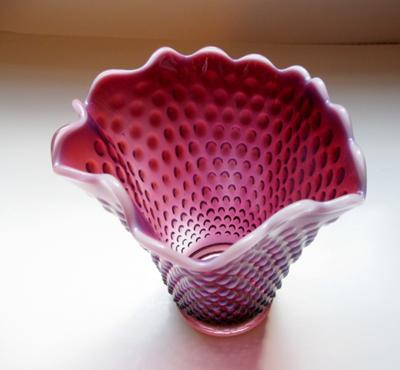
This is really esoteric for most people, but the practical upshot is that you can use gold to make red glass:
This is also called cranberry glass, and its rather nice colour comes not from gold ions but very small particles of gold embedded in the glass. So if you divide this yellow metal up finely enough, it begins to appear red. Silver also does something similar but most glass colouring as a result of the presence of metals invove their ions, not nanoparticles, making this type of glass fairly unique.