Showing posts with label inflation. Show all posts

Thursday, 10 May 2012

A fresh look at Austrian business cycle theory

I recently read a very interesting critique of the Austrian business cycle theory (ABC), and I just couldn't resist adding a few of my thoughts. Here follows my comment on the piece.

1,2,3) If a lot of capital goods turned out to be in the wrong use at the same time then a large investment in labour would be required to convert them. Capital conversion is thus a natural part of the economy but would spike at certain times - namely some time during a recession. The same applies to labour itself because retraining takes time of course, and when a person studies he is investing intellectually in that career path.

4,5) Any unnatural change in the money supply will cause a shock, it is just that those shocks are of a different kind. Gradually falling prices are no problem if the money supply is not contracting in a sudden unnatural way. Austrians, I think rightly, blame the fact that such a deflation shock can occur at all on the prior inflation. Once the money supply has been unnaturally (through fiat inflation, FRB expansion, take your pick) increased price stability becomes impossible, because as that additional money filters through the economy and increases the price level the only way to put a halt to that price increase is to actually reduce the money supply. The severity of this will be decided by what level of inflation is considered acceptable. Thus I think that it is the central bank's desire to prevent the price inflation that causes much of the "downside" problem. It would be a much better policy to refuse to change the supply in any way and allow prices to stabilise at a higher level.

6,7,8) I think it is reasonable to say that Austrians discount risk in the interest rate issue. The question then becomes, is it that lower interest rates will decrease savings because of poor returns or increase them because of lower perceived risk? I think this is at the core of what causes the business cycle, because low interest rates will cause low yield investments to become more populous while at the saver end the average man will save less because the perceived risk in a bank is usually close to 0, and thus the interest rate is very much a supply/demand. Personally I think that at very low interest rates (say, less than 3%) the savings rate is inelastic because those savings are prudential rather than an investment.
So if we assume that time preference is the wrong way to look at it and we instead consider risk perception, we need to understand why perception changes suddenly. I believe that the injection of cash into the investment sector will gradually cause the prices of capital goods to rise and at some tipping point it will become evident that some enterprises will not be profitable under the current price levels and expected future prices (for capital goods). These higher prices will thus conceivably cause a crash in the demand for capital goods as the contageon spreads. The demand crash causes unemployment from those unprofitable companies, causing a demand crash in the consumer goods sector as well, further exascerbating the unemployment problems.
As a result of these demand crashes only the highly profitable producer companies will be able to keep trading. From their perspective it is better if the money supply remains constant because then the price inflation will allow them to pay off their creditors through higher numerical revenue despite decreased sales. If the central bank elects to focus on inflation and raises interest rates these companies will face reduced revenue and higher interest rates, likely making many of them insolvent as well. I believe this is a very plausible explanation for the Great Depression, since we know deflation occurred. In a sense the motivations for deflation are immaterial - it will cause a bust proportionate to the deflation. The magnitude of the impact of the previous inflation is then a function of how far deflation is allowed to continue - if it goes to the money supply before the boom then it will be as mild as the boom, if allowed or forced all the way down to the monetary base then you could have a truly catastrophic contraction unless the boom started when the money supply was already at the monetary base.
The Austrians do have the cause of producer goods price rises correct, I believe: that low interest rates cause real savings to be lower than real investment, thereby eventually causing increased competition between consumers and producers for raw materials.
So to summarise: deflation is bad because it causes naturally profitable enterprises to go bust, inflation is bad because it causes naturally unprofitable enterprises to be started. There's a pleasing symmetry there, isn't there?

10,11,12) I agree with most of what you said here. Under my construction the idea of a malinvestment is in a sense not there. The investments are all profitable when investment is high and prices are still low. So it's not that the entrepreneurs make a mistake at the time given the conditions, it's that later price increases are unforseen and reveal those investments as unprofitable. The difference, in real terms, between a profitable and unprofitable enterprise is that the former uses fewer real goods than are given up by people when they save, and the latter uses more. The problem with a boom is that it reduces the real resources available to those enterprises on the margin and makes many otherwise profitable ventures fail when the bust comes.

Any way you cut it some companies will have to fail. There are only three options: Deflation, which destroys profitable companies; constant money, which I believe is the cure; and inflation which, in order to prevent the failure of those companies that used real resources not "saved" by consumers would have to constantly increase until the result was hyperinflation. That's the only way to get the necessary "forced saving" and hyperinflation will be inevitable as people realise their money is losing value, since by definition they will be forced to give up more real goods than they actually want to.

All of this suggests what I have been thinking about for a while: the best monetary policy is one where the central bank does not alter the money supply at all. I really need to do some analysis to find out if this theory is borne out by the facts but that is for another time. Look for future posts on this topic.

EDIT: I realised after this that the central bank can continue to inflate even at high levels without this causing hyperinflation (which as I define it is not to be thought of as a threshold level of price rises) because the economy can adjust to permanent money supply increases. It all depends on the psychology of the people and whether they are willing to accept the situation. If they do accept it then through the general ignorance of the effects of inflation real wealth will be transferred to those otherwise unprofitable enterprises.

Thursday, 22 December 2011

Hyperinflation

Hyperinflation is usually defined as any rate of inflation above 50% per month (that is, an item that cost $1 this month will cost about $1.50 next month). Inflation itself seems to be a tricky phenominon for economists, as I mentioned in an earlier post (which turned out to be riddled with factual errors but I aim to improve), but it's usually some sort of general price rise. There are several reasons for a price rise to occur under the current monetary system, and I will deal with them very briefly so that we have a foundation for considering the implications for hyperinflation.

The first kind of inflation is what everyone thinks of: banks producing slightly more money than is offset by real goods in the economy, and as a result the prices of goods go up, because the demand of money goes down slightly. Here in Australia we are accustomed to inflation of 2-3% per year, but in many of the "backwards" countries annual rates of 10% or more are normal.

The second kind of inflation also manifests as a price increase, but is not the result of too many dollars printed. If two countries with their own free floating fiat currencies engage in trade, and there is a trade deficit then the currency of the "seller" country will strengthen (their prices will drop lower than what they would otherwise have been because imports will become cheaper) and that of the "buyer" country will weaken (causing imports to become more expensive). This is functionally equivalent to two countries using the same currency trading. Currency will drain out of the buyer country into the seller country, which will be able to buy a lot of goods and services from the buyer country in return.

The third kind of inflation is really just an increase in market price of certain goods due to shortages. For instance, during a famine food prices become extremely high, because people prefer not to starve to death and will pay whatever it takes not to.

Now, I will put it to you that hyperinflation, as I define it, may involve any of those situations but is in fact a separate phenominon altogether.

Investopedia defines hyperinflation as:
Extremely rapid or out of control inflation. There is no precise numerical definition to hyperinflation. Hyperinflation is a situation where the price increases are so out of control that the concept of inflation is meaningless.
It goes on to say:
When associated with depressions, hyperinflation often occurs when there is a large increase in the money supply not supported by gross domestic product (GDP) growth, resulting in an imbalance in the supply and demand for the money. Left unchecked this causes prices to increase, as the currency loses its value.

When associated with wars, hyperinflation often occurs when there is a loss of confidence in a currency's ability to maintain its value in the aftermath. Because of this, sellers demand a risk premium to accept the currency, and they do this by raising their prices.
Now I mentioned that hyperinflation is a tough nut to crack. Look at what this article on The Library of Economics and Liberty says:
What causes hyperinflations? No single shock, no matter how severe, can explain sustained, continuously rapid growth in prices.
That is because the empirical evidence is garbled. Somtimes it is triggered by this, at other times it is triggered by that. Sometimes it happens with mild monetary inflation (my first explanation of inflation) sometimes it is only triggered when that is more severe. It is the wisdom of the Austrian economists in thinking about economics as a deductive discipline rather than an empirical science that leads me to the conclusions I will shortly be mentioning.

First I want to redefine hyperinflation.

Imagine an economy where the entire money supply is $10. Now imagine that the central bank pays its board of two governers $10 each one day, and they go to spend their money. Suddenly the amount of circulating money has increased by a factor of 3, which means that once things stabilise the prices will also be about three times as high as before, in one day. But now imagine the people don't make a stink about this. Maybe they are a very cowed population. This $20 that the two governers can spend allows them to buy pretty much everything, since no one else has anything like as much cash. They buy all the food and products of the entire country. This is an extreme example of the "inflation tax". Monetary inflation results in a slow transfer of wealth from people who get the money last to people who can spend the money first, in this case from everyone else to the two governors. I do not regard this as hyperinflation. It is extremely high inflation in my example, and there are good reasons to believe that this sort of action will cause a hyperinflation episode, but in this case, because the population just allow themselves to be robbed of real goods in exchange for paper money, the "real value" of the money supply remains the same. Everyone's price now becomes three times as high, so life can go on pretty much as it had before.

Now consider a second economy with some amount of fiat money. Again it doesn't matter exactly how much there is, it is all serving to enable trade between people. Let us say that their reserve bank's computers and printing presses are broken and they cannot print any new money for a long time. The supply of the money remains totally constant. Now one day for no specific reason, people begin to question the value of their currency. They start to spend it and buy real goods with it so they won't suffer loss if the currency tanks. As a result of lots of people doing this, the velocity of money is increasing rapidly, leading to rapid inflation. The more prices inflate, the more the money velocity goes up. Pretty soon money is spent as soon as it is earned, and prices are still climbing fast. Not long after this people simply stop accepting the currency. It has become totally worthless. They prefer to look for someone to barter with than to take the currency, because it can only be used as money and now it doesn't even serve that purpose. Now life cannot go on as before, because the "real value" of the entire money stock is now 0. Nothing. No one will accept it as payment for goods or services rendered. This is what I consider hyperinflation. It represents not a rise in prices due to an increase in the money supply but an accelerating and, if not checked, complete loss of confidence in a fiat currency. This causes prices to approach infinity. This grows out of the fourth type of inflation: an increase in money velocity.

Thus: Hyperinflation is a period in which the value of the money stock decreases significantly as people turn to foreign currencies, commodity money and barter to clear transactions.

In the first scenario prices increased extremely rapidly but the value of the entire money stock remained constant. In the second case the money stock remained constant but confidence in it waned and winked out. Since the real value of the money stock goes to 0, it doesn't matter if the central bank prints money. This will keep things going for perhaps a little while longer, but if the note's real value, as seen by everyone, is 0, then it doesn't matter if its denomination is 10 or a googolplex, it just won't be accepted as payment. At this point inflation is effectively infinite, since you can write an arbitrarily large number on the note and it won't be enough to buy a paperclip.

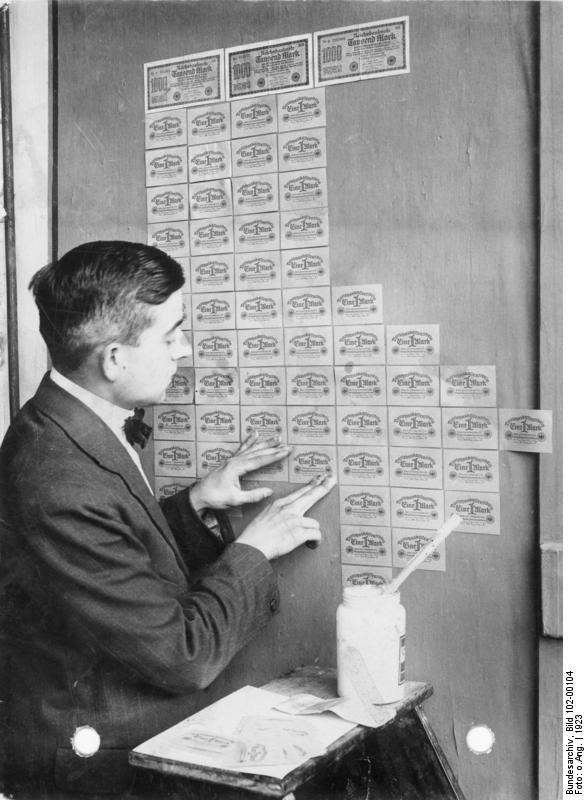
That is not to say that people don't find some use for all the worthless notes:
Wallpaper

Firewood

Civil engineering projects

The chart below shows the official (red) and unofficial (blue) exchange rate of the Zimbabwe dollar with the US dollar during their period of hyperinflation:
This chart has several interesting features. Firstly, the official value of the currency is consistently reported as less than its actual market value. Second, the inflation accelerates insanely fast: look at the vertical axis. The logarithmic scale makes it hard to appreciate just how vertical the line is on the right hand side. It actually bears a remarkable resemblance to another graph I posted on this very blog just a few months back:

To create the above chart I exponentially increased the dependent variable while exponentially decreasing the increments of the independent variable it was plotted against. So my pairs were (0,1), (24,2), (36,4), (42,8), (45,16) ... If we turn this situation around and consider the inflation as a simple loss of the real value of the money stock, this later curve becomes a straight line going down from 100% to 0% over the 48 months.

So, to recap: I define hyperinflation as those circumstances where the value of the money stock decreases sharply. This is a psychological phenominon, not a monetary one. If allowed to continue the value of the money stock will go to 0. Typically governments engage in spectacular monetary inflation to try to prop up the ailing currency but this never works, for the reasons I have outlined above. It does result in some pretty interesting banknotes though:
Seems legit

Because hyperinflation is a psychological phenominon its trigger can be hard to pin down. Basically it's anything that causes people to lose faith in the currency, often careless monetary inflation such as Weimar Germany. The trigger for the collapse of the currency rather depends. On a million things. Each situation is unique because all people are unique and the dynamics of the society will affect how the distrust spreads. So in one case it might be so many percent per month inflation that tips the balance, and somewhere else another percentage. Any way you cut it, though, it happens because the currency doesn't have intrinsic worth, and because the currency's production is controlled by a central bank whence the notes must be accepted by the people under pain of fine and or imprisonment.

Hyperinflation can never occur with a commodity money, because if it loses value as a medium of exchange you can use it for other things. Even gold, one of the most useless metals, can serve as pretty nice jewelery and these days we plate quite a lot of it on to electrical connectors to prevent corrosion. Printed paper, on the other hand, is good for nothing but to be pulped and made into toilet paper or charcoal briquettes. It's a pretty slow way of wallpapering your house - though I think it would be worth it just for the conversations you could have - and it doesn't burn that well. Thus if we want to make a currency that is really hyperinflation proof, it has to be on a commodity standard or just be a commodity.

So to answer the question that everyone always asks: can it happen to us. The answer is yes, it can happen to any fiat currency, and because the probability is there, there's every chance that one day it actually will happen, even if we in the Anglophone countries have been spared this pain thus far. Will it happen soon? That's a tough one. I don't think anyone can make that call. It's a divergent condition based on chaotic factors. Impossible to predict. You should be wary if our inflation gets about 10%, though. We're used to 3% and 10% would be a bit of a shocker. Perhaps enough to start driving people away from AUD and into whatever looks juicy at the time. If the reserve bank did insane amounts of quantitative easing that could potentially result in inflation if the banks were to actually lend that money out. Under the current low inflation most people will keep AUD, so providing there's no significant change in the status quo, AUD is safe for now. And because our notes are plastic, if they do lose value you can bung them in the oven and in a few minutes you have some rather fetching earrings, pendants, or mosaic tiles.